Gemma 4 Guides
Kimi K3: Moonshot AI's 2.8T Open-Weight Model Explained
Kimi K3: Moonshot AI's 2.8T Open-Weight Model, Explained
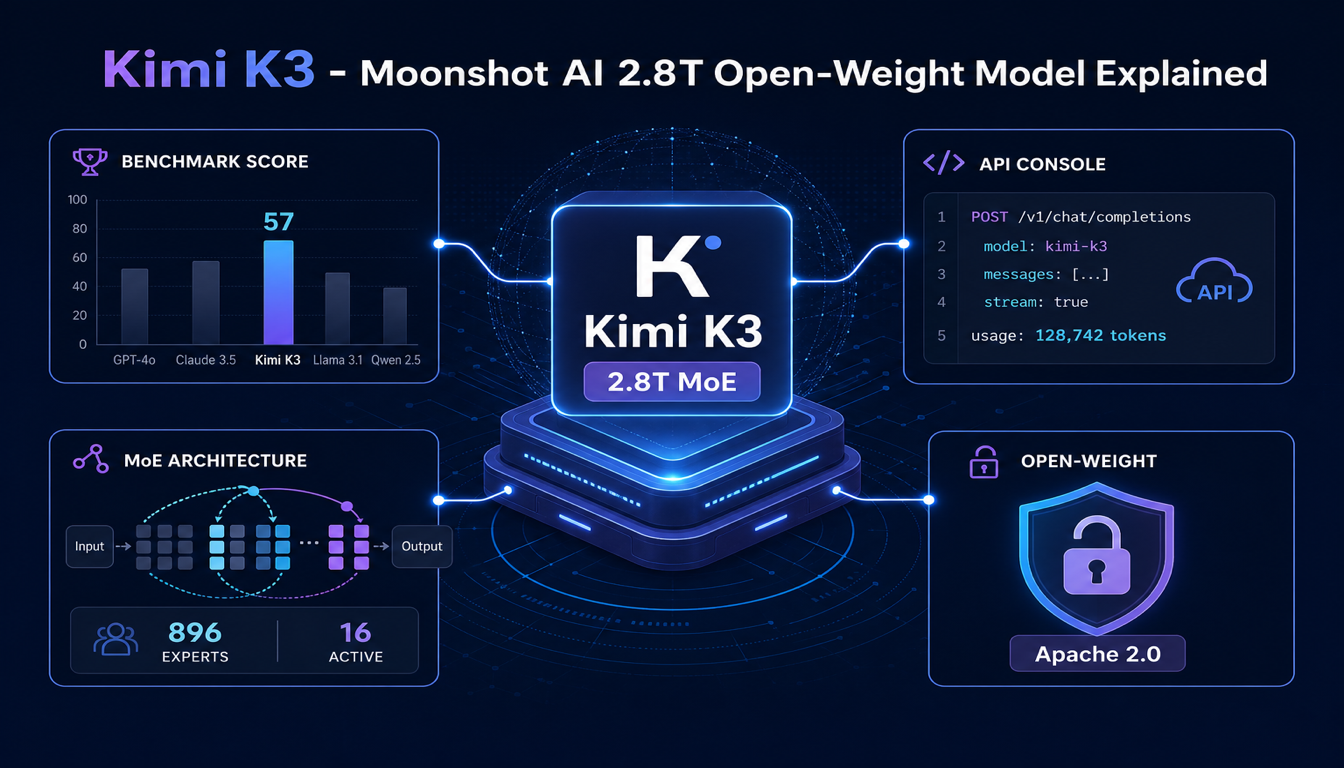
Moonshot AI released Kimi K3 on July 16, 2026, and within a day it had climbed to the top of LMArena's Frontend Code Arena, overtaking Claude Fable 5, and posted an Artificial Analysis Intelligence Index score ahead of Claude Opus 4.8. At 2.8 trillion parameters, it is being described as the largest open-weight model released to date — from a company that, three years earlier, was still a Beijing startup few outside China had heard of.
This guide covers what Kimi K3 actually is, what's confirmed versus what's still pending (the public weights are not downloadable yet), and where to go for the numbers that matter for a real evaluation.
Quick answer
- Released: July 16, 2026, by Moonshot AI (founded by CEO Yang Zhilin).
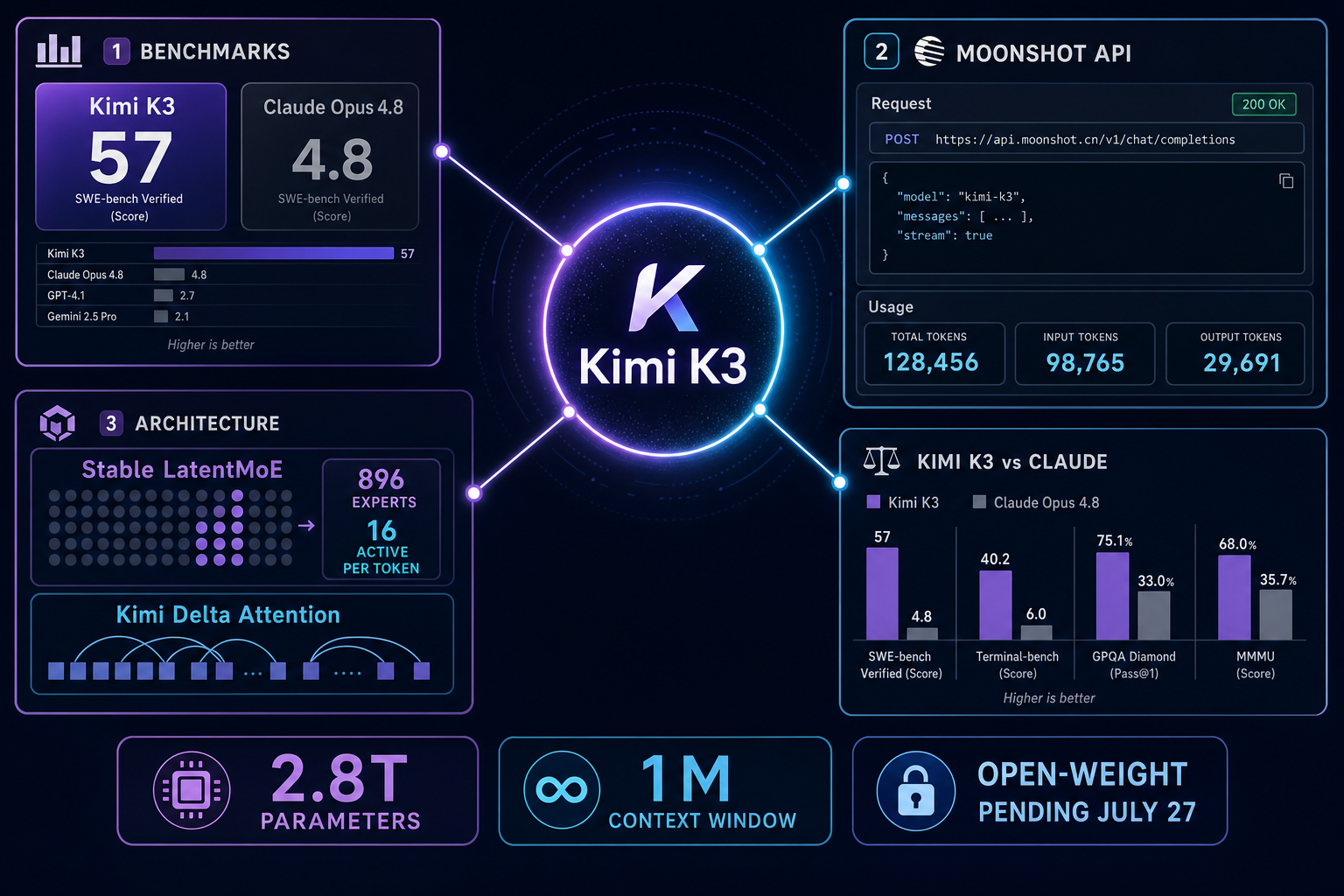
- Size: 2.8 trillion total parameters — the largest open-weight model released so far.
- Architecture: Mixture-of-Experts using Moonshot's Stable LatentMoE framework (16 of 896 experts active per token), built on two in-house innovations: Kimi Delta Attention (a hybrid linear attention mechanism) and Attention Residuals (a drop-in replacement for standard residual connections).
- Context window: 1,048,576 tokens (~1M), with native visual understanding and an always-on "thinking mode."
- Open weights: Announced as open-weight under a Modified MIT-style license, but the downloadable weights were not live at launch — Moonshot has committed to publishing them by July 27, 2026. Until then, "open source" describes the plan, not something you can download.
- Access today: Moonshot's own API (
platform.kimi.ai), OpenRouter (moonshotai/kimi-k3), and the consumer Kimi app/web chat. Hugging Face self-hosting is not available yet. - Standing vs. Claude: Beats Claude Opus 4.8 on the Artificial Analysis Intelligence Index and on several agentic/coding benchmarks; trails the newer Claude Fable 5 on a majority of benchmarks but wins on long-horizon agentic coding and costs a fraction of the price.
What Kimi K3 actually is
Kimi K3 is Moonshot AI's newest flagship model, positioned as an open-weight frontier system that goes head-to-head with the biggest closed-source labs on agentic coding, tool use, and general reasoning — while publishing (or, for now, promising to publish) the weights.
The framing that matters: this is not an incremental point release. Moonshot jumped straight to a 2.8T-parameter model, more than double the size of its predecessor Kimi K2.6 (~1T parameters), and paired it with new architecture rather than just more scale on the old recipe. The market reaction was immediate — coverage tied the release to a broader sell-off in AI chip stocks, on the logic that a model this capable, this cheap, and openly available changes the calculus for how much compute the rest of the industry needs to buy.
Architecture and specs
Two techniques do most of the work under the hood, and both were previously published as open research by the Moonshot team before showing up in a shipped model:
- Kimi Delta Attention — a hybrid linear attention mechanism designed to keep long-context inference fast without the usual quadratic blowup of standard attention.
- Attention Residuals — a drop-in replacement for conventional residual connections that Moonshot says delivers more consistent gains as the model scales.
- Stable LatentMoE — the routing framework behind the mixture-of-experts layer. Of 896 total experts, 16 are active per token, which is how a 2.8T-parameter model stays computationally tractable instead of requiring 2.8T parameters' worth of compute on every forward pass.
Alongside the architecture, K3 ships with:
- A 1,048,576-token context window (~1M tokens) covering both input and output.
- Native visual understanding — image input is built in, not bolted on.
- An always-on reasoning mode ("thinking mode") rather than a toggle you have to remember to flip.
Moonshot has said a full technical report with training and evaluation details will accompany the public weight release. Until that lands, treat architectural specifics beyond what's summarized here as provisional.
Is Kimi K3 open source?
This is the single most-searched question about K3, and the honest answer has two parts:
The plan is open-weight. Moonshot has stated K3 will ship under a Modified MIT-style license, following the same approach as Kimi K2.6 (permissive for the overwhelming majority of users, with an attribution clause that only kicks in at very large deployment scale).
The weights are not downloadable yet. At launch, Kimi K3 is reachable only through Moonshot's hosted API, OpenRouter, and the consumer app — none of which require or provide the underlying model file. Moonshot has committed to publishing the actual weights, along with the technical report, by July 27, 2026. Until that date, "Kimi K3 is open source" is a statement about intent and licensing, not something you can git clone or run with vLLM today.
If you specifically need self-hosted, on-prem inference, the practical move right now is to bookmark this and check back after July 27 — and budget for the hardware conversation separately, since a 2.8T-parameter model (even a sparse MoE one) will need substantially more memory than K2.6 did.
How Kimi K3 performs
Full breakdown: Kimi K3 benchmarks: how it actually stacks up
The short version: on the Artificial Analysis Intelligence Index, K3 scores 57, ahead of Claude Opus 4.8's 56 but behind Claude Fable 5's 60. On agentic benchmarks specifically — GDPval-AA, BrowseComp, long-horizon coding — K3 is genuinely competitive with, and sometimes ahead of, the most expensive closed-source models on the market. It also took the #1 spot on LMArena's Frontend Code Arena within hours of release, passing Claude Fable 5.
Where it's weaker: reasoning-heavy academic benchmarks like GPQA Diamond and Humanity's Last Exam, where Claude Opus 4.8 still edges it out.
What Kimi K3 costs
Full breakdown: Kimi K3 pricing: API costs and subscription plans
The short version: the API is $3 per million input tokens and $15 per million output tokens, with cached input dropping to $0.30 per million — a 90% discount that matters a lot for agentic and RAG-style workloads. That undercuts Claude Opus 4.8 by roughly 1.7x on both input and output. The consumer app has five subscription tiers from free (Adagio) up to $199/month (Vivace), though those cover the chat app and tools, not API usage.
How it compares to Claude and other models
Full breakdown: Kimi K3 vs Claude: Fable 5 and Opus 4.8 compared
The short version: against Claude Opus 4.8, K3 wins on both benchmarks and price — it's a fairly clean upgrade if Opus 4.8 was your baseline. Against the newer Claude Fable 5, the picture is closer: Fable 5 wins more benchmarks overall (roughly 8 of 14 in head-to-head comparisons), especially on frontier engineering and vision tasks, but K3 wins on long-horizon agentic coding and terminal-driven work, and does it at a fraction of Fable 5's cost.
K3 also arrived in the same window as GLM 5.2 and earlier Kimi K2.6 as competing open-weight options — if you're evaluating open models specifically, our GLM 5.2 review and Kimi K2.6 vs GLM-5.1 comparison are useful companion reads while a direct K3-vs-GLM-5.2 breakdown is in the works.
How to access Kimi K3 today
Four ways in, none of which currently require the (unreleased) weights:
- Moonshot's own API at
platform.kimi.ai— sign up, create a key, and you're billed per token. See the pricing guide for setup steps. - OpenRouter, listed as
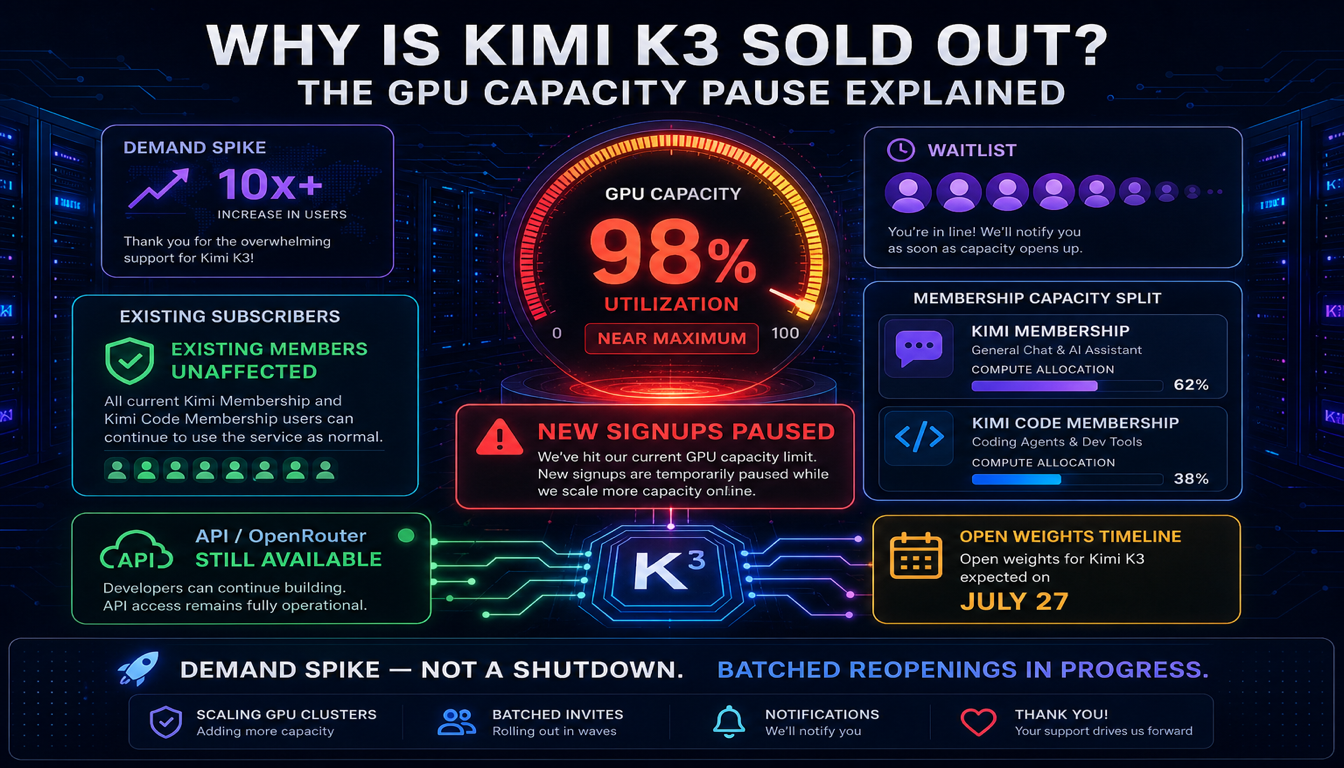
moonshotai/kimi-k3— useful if you already route multiple providers through OpenRouter and want K3 as a drop-in option. - The consumer Kimi app and web chat — free tier available (Adagio), with paid tiers up to $199/month for heavier usage, agent credits, and tools. This is separate billing from the API. Note: new paid subscription signups were temporarily paused starting July 19, 2026 after demand exceeded Moonshot's GPU capacity — see why Kimi K3 sold out for the current status.
- Kimi Code, Moonshot's terminal coding agent, for subscribers who want K3 wired into a CLI coding workflow.
What's not available yet: Hugging Face weights, and therefore any form of true self-hosting.
Kimi K3 vs Kimi K2.6: what actually changed
If you evaluated or deployed Kimi K2.6 earlier in 2026, K3 is not a minor version bump:
| Kimi K2.6 | Kimi K3 | |
|---|---|---|
| Total parameters | ~1T | 2.8T |
| Context window | 256K | ~1M |
| Architecture | Standard MoE attention | Kimi Delta Attention + Attention Residuals + Stable LatentMoE |
| Visual input | Image + experimental video | Native image understanding |
| Reasoning mode | Toggle (Thinking / Instant) | Always-on thinking mode |
| Open weights | Available on Hugging Face | Pending, expected July 27, 2026 |
K2.6 remains a reasonable choice if you already have it integrated and don't need the larger context or the latest benchmark position. For any new evaluation, start with K3.
Who should use Kimi K3
- Teams building agentic coding tools — the long-horizon agent and terminal benchmarks are where K3 is strongest relative to price.
- Anyone currently paying for Claude Opus 4.8 where cost-per-task matters — K3 beats it on benchmarks most teams care about and costs meaningfully less.
- Frontend-heavy workflows — the #1 LMArena Frontend Code Arena result is a genuine, verifiable signal, not just a self-reported number.
- Long-context and RAG pipelines that can benefit from the ~1M context window and the 90%-off cached-input pricing.
Who should wait
- Anyone who needs self-hosted, on-prem inference today. The weights aren't out. Check back after July 27, 2026.
- Teams whose workload leans heavily on academic reasoning benchmarks (competition math, GPQA-style science) — Claude Opus 4.8 and Fable 5 still have an edge there.
- Anyone who needs a fully mature, independently-verified benchmark picture. K3 is days old; some of the numbers circulating are still vendor-reported or from a single aggregator, and will likely be refined as more of the community runs its own evaluations.
FAQ
What is Kimi K3? Kimi K3 is Moonshot AI's flagship large language model, released July 16, 2026. It's a 2.8-trillion-parameter mixture-of-experts model with a ~1M-token context window, native visual understanding, and an always-on reasoning mode, positioned as an open-weight competitor to Claude and GPT.
Is Kimi K3 open source? It's designed to be open-weight under a Modified MIT-style license, but the actual downloadable weights were not available at launch. Moonshot has committed to publishing them, along with a full technical report, by July 27, 2026.
Is Kimi K3 free? The consumer chat app has a free tier (Adagio). The API is paid, at $3/M input and $15/M output tokens, with no free production tier. See the pricing guide for the full breakdown.
How do I use Kimi K3?
Today, through Moonshot's API at platform.kimi.ai, through OpenRouter as moonshotai/kimi-k3, or through the consumer Kimi app and web chat. Self-hosting isn't possible until the public weights ship.
Is Kimi K3 better than Claude? It depends which Claude. K3 beats Claude Opus 4.8 on the Artificial Analysis Intelligence Index and most agentic benchmarks, at a lower price. Against the newer Claude Fable 5, Fable 5 wins more benchmarks overall, but K3 wins on long-horizon agentic coding and is dramatically cheaper. See the full comparison.
How big is Kimi K3? 2.8 trillion total parameters, using a mixture-of-experts design (Stable LatentMoE) that activates 16 of 896 experts per token — so inference cost is far lower than the total parameter count implies.
Related guides
- Kimi K3 benchmarks: how it actually stacks up
- Kimi K3 pricing: API costs and subscription plans
- Kimi K3 vs Claude: Fable 5 and Opus 4.8 compared
- Kimi K3 vs Qwen 3.8: what's confirmed, what isn't
- Why is Kimi K3 sold out? The GPU capacity pause explained
- Kimi K2.6 review: benchmarks, API, and K2.7 Code update
- Kimi K2.6 vs GLM-5.1
- GLM 5.2 review
Related guides
Continue through the Gemma 4 cluster with the next guide that matches your current decision.
Why Is Kimi K3 Sold Out? The GPU Capacity Pause Explained
Kimi K3 isn't discontinued or actually "sold out" — Moonshot paused new subscription signups after demand maxed out its GPU capacity within 48 hours of launch. Here's what that means if you're trying to get access right now.
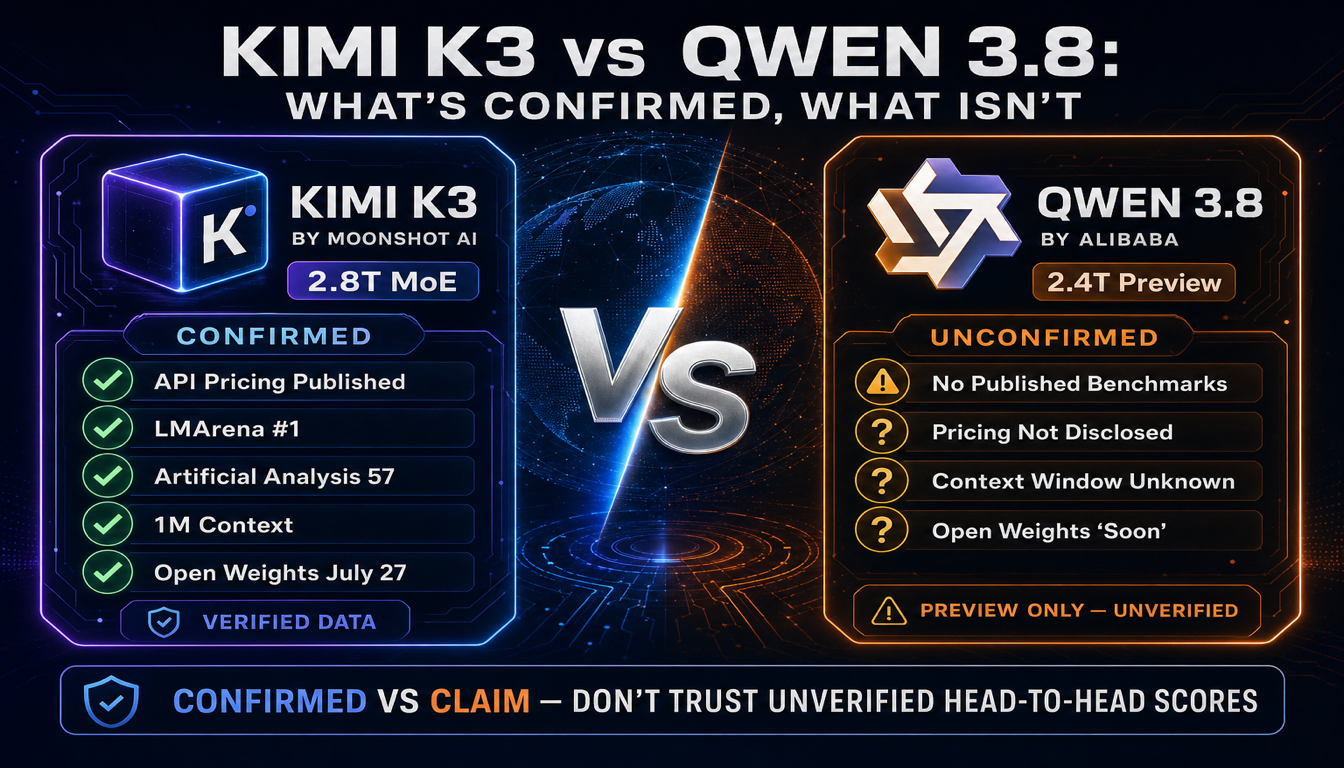
Kimi K3 vs Qwen 3.8: What's Confirmed, What Isn't (July 2026)
Alibaba previewed Qwen 3.8 three days after Kimi K3 launched, calling it "second only to Fable 5." Problem: Qwen 3.8 doesn't have a single published benchmark yet. Here's what's actually confirmed on both sides before you pick one.
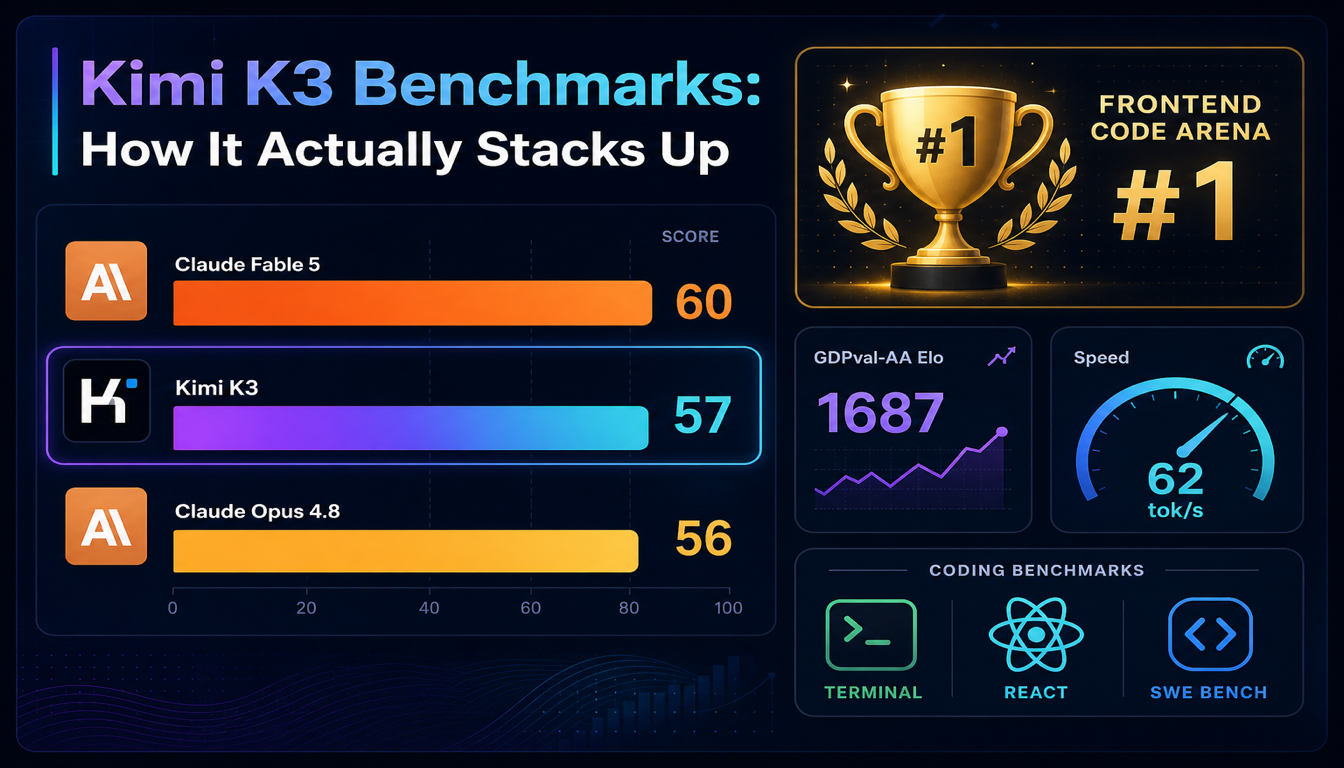
Kimi K3 Benchmarks: How It Actually Stacks Up
Kimi K3 hit #1 on LMArena's Frontend Code Arena and beat Claude Opus 4.8 on the Artificial Analysis Intelligence Index within a day of launch. Here's what the numbers actually say — and where they don't tell the whole story.
Still deciding what to read next?
Go back to the guide hub to browse model comparisons, setup walkthroughs, and hardware planning pages.