Gemma 4 Guides
Kimi K2.6 vs GLM-5.1: Updated Notes for K2.7 Code and GLM-5.2

Kimi K2.6 vs GLM-5.1: Benchmarks, Context Window, Pricing, and Which Model Fits Better
In April 2026 two of the strongest open-weight models in the world came out of China within two weeks of each other: GLM-5.1 from Z.AI on April 7, and Kimi K2.6 from Moonshot AI on April 20. Both target long-horizon coding and autonomous agent workloads. Both claim frontier-level performance. Both are permissively licensed. But they are genuinely different models with different strengths, and the right pick depends on what you are building.
This comparison walks through architecture, benchmarks, multimodal support, context, pricing, and API experience — using each vendor's own published numbers — and ends with a direct recommendation by workflow.
June 2026 update: treat this as an April 2026 historical snapshot. Kimi's platform now lists K2.7 Code as the stronger coding model, and Z.AI now recommends GLM-5.2 in its newer coding/devpack materials. If you are making a fresh selection today, include K2.7 Code and GLM-5.2 rather than testing only K2.6 and GLM-5.1.

Quick answer
- Pick Kimi K2.6 if you need native vision or video input, want the 256K context window, integrate heavily with OpenAI-compatible SDKs, or run agent-swarm workloads with parallel sub-agents.
- Evaluate Kimi K2.7 Code first if the workload is coding-agent-first and you do not specifically need to stay on K2.6.
- Pick GLM-5.1 if you are maintaining an existing GLM-5.1 evaluation or need its historical text-only long-output profile.
- Evaluate GLM-5.2 first for new Z.AI coding/devpack workflows, because it is the newer line Z.AI is currently positioning for that use case.
- Neither is strictly "better." Architecture, modality, and pricing differ enough that the honest answer depends on your workflow.
Release timing and positioning
| Kimi K2.6 | GLM-5.1 | |
|---|---|---|
| Vendor | Moonshot AI | Z.AI (formerly Zhipu AI) |
| Release date | April 20, 2026 | April 7, 2026 |
| Positioning | Open-weight, multimodal, agentic coding + swarm | Open-weight, text-only, long-horizon engineering |
| License | Modified MIT | MIT |
Both vendors pitch the same story: long-horizon autonomous coding by open-weight models built outside the US compute stack. The packaging differs — Kimi leans into multimodality and multi-agent orchestration, Z.AI leans into sustained single-task execution.
Model capability snapshot
| Kimi K2.6 | GLM-5.1 | |
|---|---|---|
| Architecture | Mixture-of-Experts | Mixture-of-Experts |
| Total parameters | ~1T | ~754B |
| Active parameters | ~32B | ~40B |
| Context window | 256K | 200K |
| Max output | (uses context window) | 128K |
| Text input | Yes | Yes |
| Image input | Yes (native, via MoonViT) | No |
| Video input | Yes (native, experimental on third-party engines) | No |
| Thinking mode | Yes | Yes |
| Function calling | Yes | Yes |
| MCP support | Yes | Yes |
| Structured output | Yes | Yes |
The first-order difference jumps out of this table: Kimi K2.6 is multimodal, GLM-5.1 is text-only. Z.AI's own documentation and third-party reviewers consistently confirm GLM-5.1 does not accept image or audio input. If your product involves screenshots, design mockups, video analysis, or PDF pages as images, Kimi is the only one of the two that fits.
The second-order difference: context versus output length. Kimi offers a longer context (256K vs 200K), while GLM-5.1 emphasizes a larger max output window (128K). That matters for different tasks — loading an entire codebase favors Kimi's context; generating an extremely long single piece of code or documentation favors GLM's output budget.
Coding and agent benchmark claims
Both vendors publish official benchmark tables. These are self-reported on each vendor's preferred harness, so treat them as positioning rather than head-to-head leaderboard results.
SWE-Bench Pro (coding)
| Model | Score (self-reported) |
|---|---|
| GLM-5.1 | 58.4 |
| Kimi K2.6 | 58.6 |
Within margin of error. Both vendors claim to have topped GPT-5.4 and Claude Opus 4.6 on this benchmark — and on their own runs, they both do. A point of separation between them is not a meaningful real-world gap.
SWE-Bench Verified
Kimi K2.6 reports 80.2. GLM-5.1 is reported at roughly 77.8 on the same benchmark in earlier Z.AI materials. Kimi edges out on this one.
Terminal-Bench 2.0
Kimi K2.6 reports 66.7 on the Terminus-2 harness. GLM-5.1 reports 63.5 on Terminus-2 and up to 66.5 on the Claude Code harness. Again, within reasonable proximity — the harness matters as much as the model.
Agentic / browsing
- Kimi K2.6: BrowseComp 83.2, Toolathlon 50.0, HLE-with-tools 54.0.
- GLM-5.1: BrowseComp 68.0 (79.3 with context management), MCP-Atlas 71.8, τ³-Bench 70.6.
These are measuring different things under different harnesses, so direct comparison is genuinely misleading. The defensible summary: both models are competitive with closed-source frontier models on agentic coding tasks, with Kimi tilted toward tool-use-heavy benchmarks and GLM tilted toward long, iterative execution.
Long-horizon demos
Each vendor published an anchor demo with their release:
- Kimi K2.6: 12+ hours of continuous execution optimizing Qwen3.5-0.8B local inference in Zig, 4,000+ tool calls, ultimately ~20% faster than LM Studio; and a 13-hour autonomous refactor of
exchange-corewith roughly 185% medium-throughput gain. - GLM-5.1: 8 hours of continuous autonomous work on a single engineering task, 655 iterations on a vector database optimization pipeline, boosting query throughput to 6.9× the initial production version.
Different flavors of the same pitch. Kimi emphasizes breadth (many languages, many domains, tool calls in parallel). GLM emphasizes depth (one task, one codebase, long iteration loop).
Multimodal difference
This is the cleanest, most actionable difference between the two models and it is worth isolating:
| Input type | Kimi K2.6 | GLM-5.1 |
|---|---|---|
| Text | ✅ | ✅ |
| Image | ✅ | ❌ |
| Video | ✅ (experimental on third-party engines) | ❌ |
If your workflow includes any of the following, GLM-5.1 is not in the running and you should stop comparing:
- Converting design mockups or screenshots into working front-end code
- Analyzing PDFs visually (as opposed to text-extracted)
- Reading plots, diagrams, or figures inside documents
- Any video input task
If your workflow is pure text — source files, logs, documentation, natural-language prompts — modality is not a differentiator and the decision shifts to the pricing, context, and workflow-fit sections below.
API and integration experience
Both offer OpenAI-style APIs, but the developer experience diverges.
Kimi K2.6. Moonshot's API is fully OpenAI-compatible at https://api.moonshot.ai/v1. Any OpenAI SDK works as a drop-in client — change the base URL and the model string and you are done. Supports thinking and non-thinking modes, tool calling, structured output, and native multimodal content parts. Docs are in Chinese and English.
GLM-5.1. Z.AI's BigModel API also exposes an OpenAI-compatible surface, with support for thinking mode, function calling, MCP integration, structured output, and context caching. Rich engineering-agent tooling, with documented workflows for Claude Code and OpenClaw.
If you already have an OpenAI client pointing at production and you are just swapping models, both are easy to plug in. If you are migrating from Claude Code or a similar CLI coding agent, both vendors have explicit integration guides.
Pricing comparison
This is the area where casual "which is cheaper?" answers are most misleading, because the two vendors publish in different currencies and use different billing shapes.
Kimi K2.6 and K2.7 Code (global pricing, USD)
| Model | Cache hit | Input | Output |
|---|---|---|---|
| Kimi K2.6 | $0.16 / MTok | $0.95 / MTok | $4.00 / MTok |
| Kimi K2.7 Code | $0.19 / MTok | $0.95 / MTok | $4.00 / MTok |
GLM-5.1 / GLM-5.2 pricing
Z.AI's published GLM-5.1 rates have changed across pages and plans. For new work, check the live Z.AI pricing page for GLM-5.2 and any GLM Coding Plan subscription instead of copying an old GLM-5.1 table.
| Item | What to verify |
|---|---|
| API input / output | Current Z.AI model pricing page |
| Cached input | Current cache pricing for your selected model |
| Coding subscription | Current GLM Coding Plan tiers |
| Context / max output | Current model docs for GLM-5.1 vs GLM-5.2 |
Z.AI also offers a GLM Coding Plan subscription separate from API billing, with monthly tiers aimed at individual coding-agent usage.
Reading the pricing honestly
There are three reasons a single "cheaper than" sentence is wrong here:
- Different pricing surfaces. Kimi's global page currently presents USD/MTok rates, while Z.AI may expose API and coding-plan pricing separately.
- Different cache economics. Kimi's cached-vs-uncached ratio is roughly 6×; GLM's is roughly 5–6×. In both cases, cache-friendly prompt design dominates the effective bill.
- Different usage shapes. If your workload uses vision, Kimi is the only option — pricing comparison is moot. If your workload generates enormous outputs, GLM's output rate and 128K output ceiling matter more than Kimi's. If your workload is agent-swarm–style, Kimi's swarm features may save you more than GLM's cheaper per-token rate costs you.
The practical advice: list the current official prices from each vendor, include coding-plan subscriptions where relevant, and then model your actual token mix (cache hit / input / output / tool calls / web search) before concluding anything about cost.
Which one should you choose
Choose Kimi K2.6 if:
- You need image or video input — this is the single cleanest deciding factor.
- You want the longest usable context window (256K) for whole-codebase or long-document work.
- You are building around multi-agent orchestration or plan to use Moonshot's Agent Swarm capabilities.
- You already run OpenAI SDK-based services and want the drop-in OpenAI-compatible endpoint.
- You need strong Chinese-language capability.
- You want to integrate tightly with Claude Code, Codex, OpenCode, OpenClaw, or Kimi Code.
Evaluate Kimi K2.7 Code first if:
- Your workload is coding-agent-first.
- You are starting a new benchmark rather than maintaining an existing K2.6 integration.
- You want Kimi's newer coding model without changing provider ecosystem.
Choose GLM-5.1 if:
- Your workload is pure text and you do not need any multimodality.
- You need very long single-response outputs — the 128K max output ceiling is meaningful.
- You are sensitive to the self-reported SWE-Bench Pro leaderboard position for marketing or procurement reasons.
- You need MIT-licensed weights (GLM-5.1's license is a clean MIT, while Kimi's is a Modified MIT with an attribution clause for very large deployments).
- You prefer USD-denominated API billing over RMB.
- Your workflow is one-task, one-agent, extremely long runs — the "8-hour autonomous Linux desktop build" and "655 iterations" shape of task.
Evaluate GLM-5.2 first if:
- You are choosing a current Z.AI model for coding/devpack workflows.
- You want the newer GLM line rather than a historical April 2026 baseline.
Short recommendation by workflow
| Workflow | Pick |
|---|---|
| Screenshot → working UI | Kimi line; test K2.7 Code if coding is central |
| Autonomous multi-agent coding swarm | Kimi line; test K2.7 Code first |
| Long single-task engineering optimization | GLM line; test GLM-5.2 first |
| Generating very long documents or code in one go | GLM line; verify current GLM-5.2 output limits |
| RAG over a 200K+ knowledge base | Kimi K2.6 / K2.7 Code depending on workload |
| Code review agent in VS Code / IDE | Test K2.7 Code and GLM-5.2 side by side |
| Chinese-first bilingual product | Kimi K2.6 |
| Pure-text long-horizon agent without vision | Close call, test both |
Final verdict
This is not a "winner" comparison. Kimi K2.6 and GLM-5.1 were both legitimately frontier-class open-weight models in the April 2026 window, and the choice between them was best made on modality and workflow shape, not on a single-digit benchmark gap. For new work in June 2026, the same principle applies, but the model names to test first are Kimi K2.7 Code and GLM-5.2.
The cleanest filter: do you need vision or video input? If yes, Kimi K2.6 is your answer and GLM-5.1 is out of the running. If no, the decision becomes about output length, pricing currency and shape, and which vendor's integrations and docs you prefer. For many teams, the right move is to implement both behind an OpenAI-compatible client abstraction, run a week of production traffic, and let the actual cost-per-task numbers and reliability telemetry decide.
FAQ
Which is better for coding, Kimi K2.6 or GLM-5.1? As an April 2026 comparison, self-reported benchmarks were close. For fresh coding-agent work, compare Kimi K2.7 Code against GLM-5.2 instead of stopping at K2.6 vs GLM-5.1.
Does Kimi K2.6 support images and video? Yes. Kimi K2.6 is natively multimodal and accepts text, image, and video input. Video is marked experimental on third-party deployments.
Is GLM-5.1 multimodal? No. GLM-5.1 is text-only. For multimodal tasks, Z.AI publishes a separate GLM-5V-Turbo model; for straight GLM-5.1, image and video input are not supported.
Which model has the longer context window? Kimi K2.6 has a 256K context window. GLM-5.1 has a 200K context window. GLM-5.1's 128K max output is substantially longer than typical, which is a different lever from context length.
Which model is cheaper to use through the API? Neither has a clean "cheaper" answer because effective cost depends on cache-hit rate, output length, tool calls, account tier, and any coding-plan subscription. Model your actual token mix per request before concluding.
Are both of these models open source? Yes, both publish weights on Hugging Face. GLM-5.1 uses the MIT license. Kimi K2.6 uses a Modified MIT license with a visible-attribution clause for very large deployments (roughly 100M+ MAU or $20M+ monthly revenue). For nearly all teams both are effectively permissive.
Related guides
Continue through the Gemma 4 cluster with the next guide that matches your current decision.

Kimi K2.6 Review: Benchmarks, API, and K2.7 Code Update
Kimi K2.6 arrived on April 20, 2026 as an open-weight agentic coding model with 256K context, native vision and video input, and an aggressive agent-swarm story. This review breaks down what's real, what's marketing, and who should actually switch.
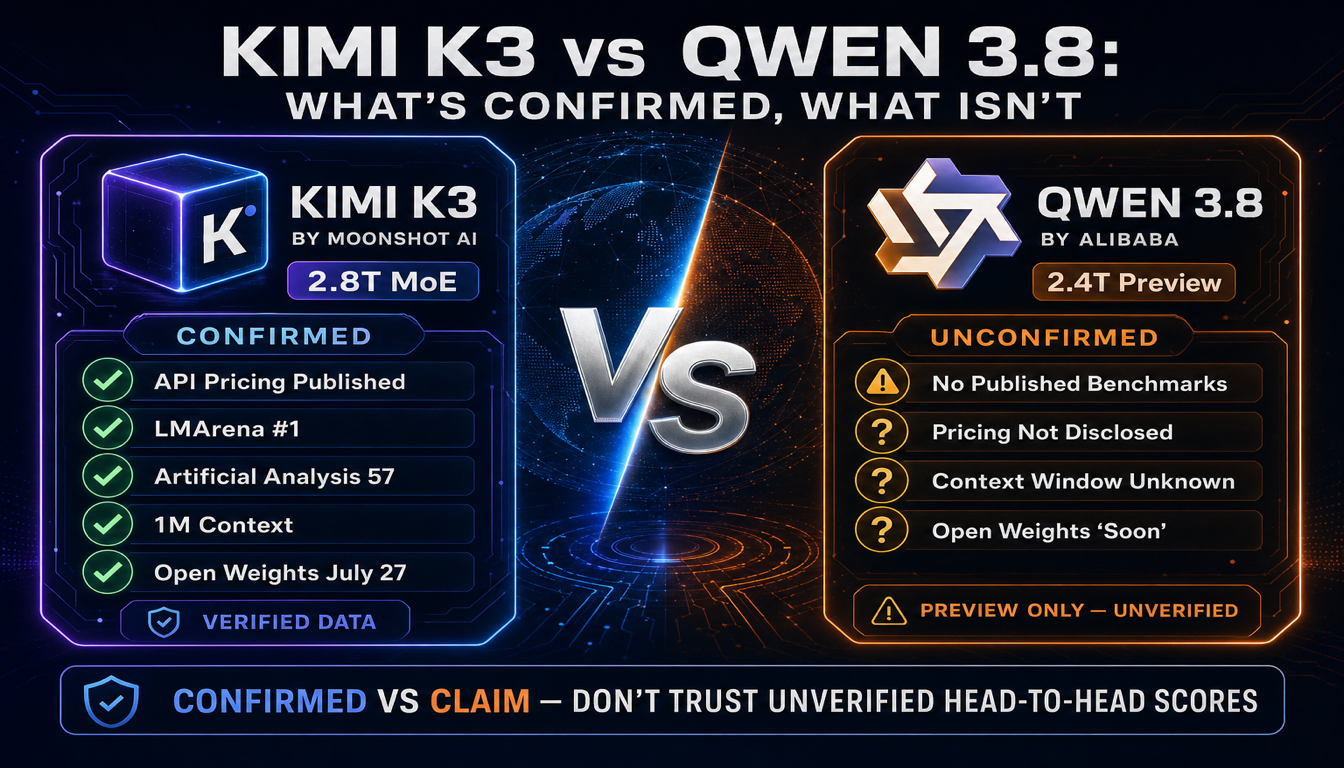
Kimi K3 vs Qwen 3.8: What's Confirmed, What Isn't (July 2026)
Alibaba previewed Qwen 3.8 three days after Kimi K3 launched, calling it "second only to Fable 5." Problem: Qwen 3.8 doesn't have a single published benchmark yet. Here's what's actually confirmed on both sides before you pick one.
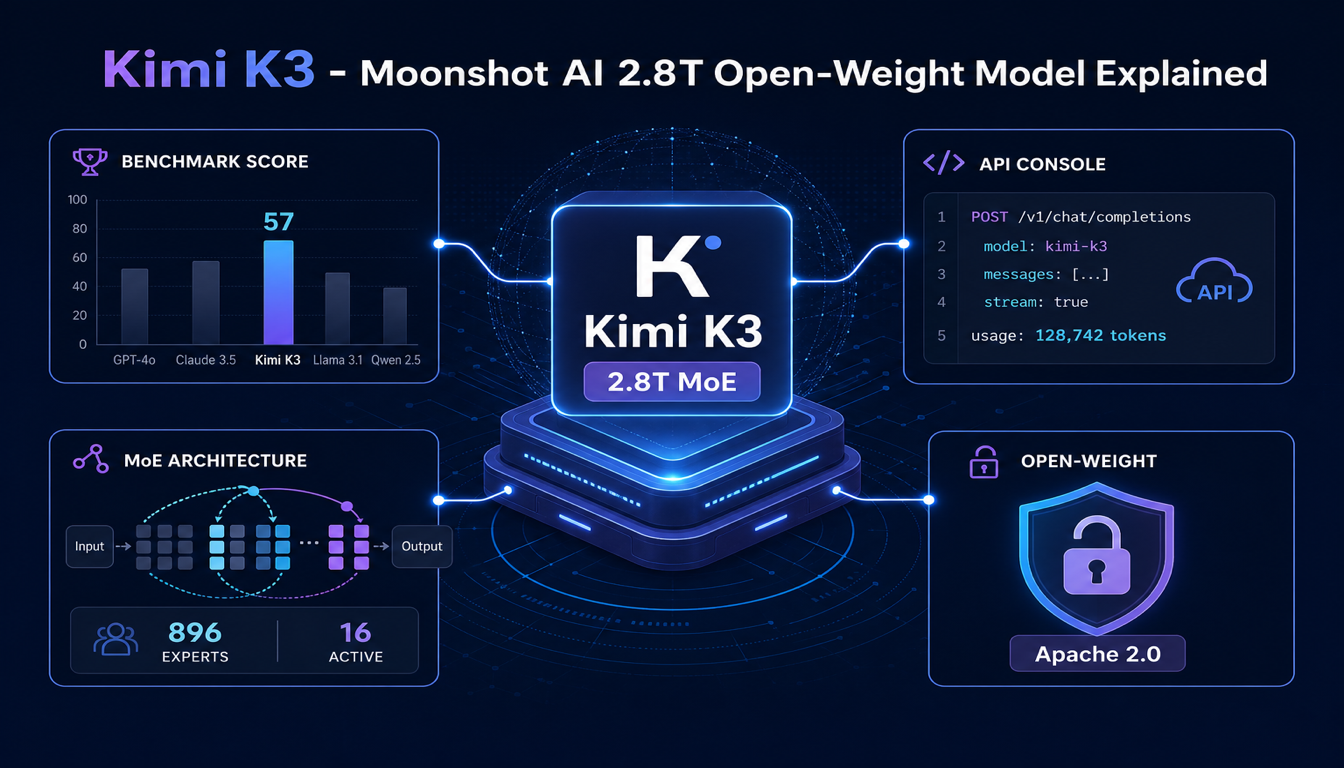
Kimi K3: Moonshot AI's 2.8T Open-Weight Model Explained
Moonshot AI's Kimi K3 launched July 16, 2026 as a 2.8-trillion-parameter open-weight model that beats Claude Opus 4.8 on several benchmarks. Here is what it actually is, what's still missing, and how to try it today.
Still deciding what to read next?
Go back to the guide hub to browse model comparisons, setup walkthroughs, and hardware planning pages.