
Gemma 4 Guides
GLM 5.2 Review: Benchmarks, Coding Performance & Is It Worth Using?
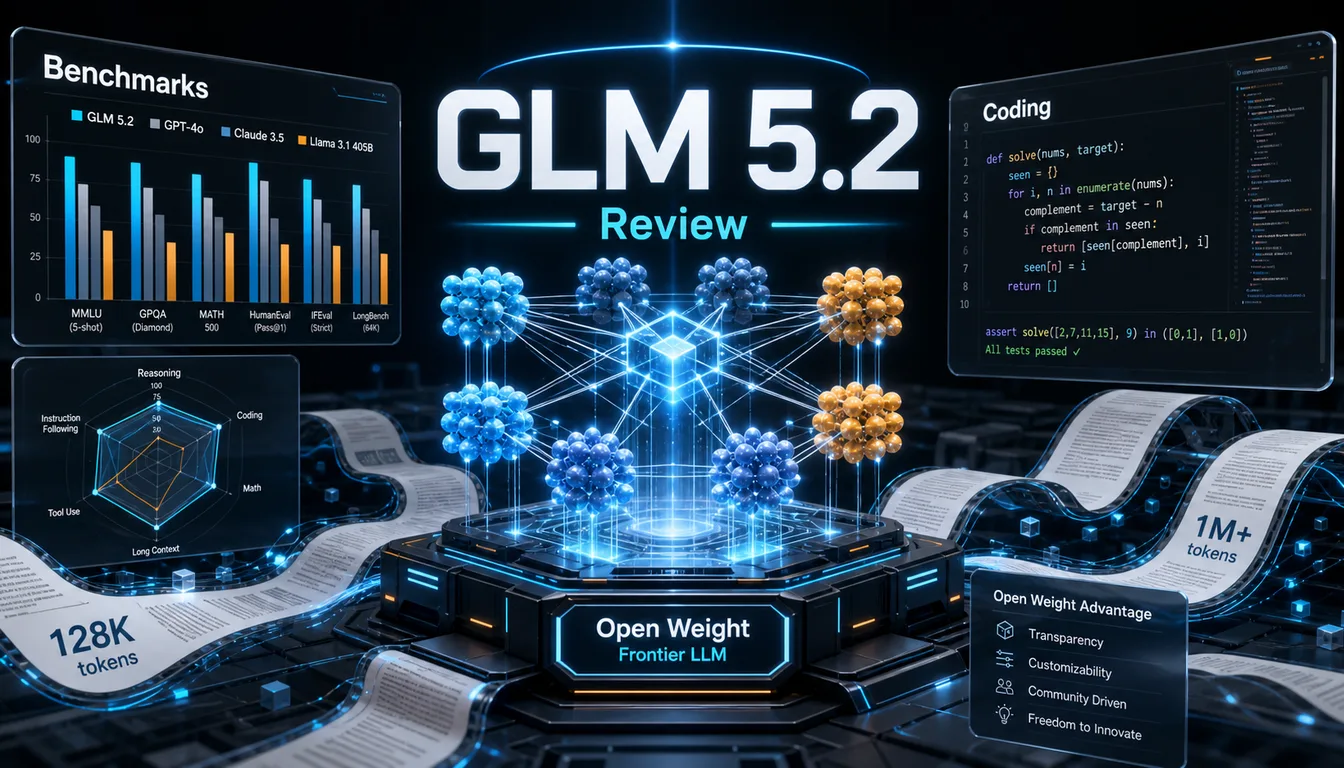
GLM 5.2 Review: Is Zhipu AI's Open-Weight Flagship Worth Your Attention?
GLM 5.2 is the latest open-weight model from Zhipu AI (now operating as Z.ai), released on June 13, 2026. It is the first open model to genuinely close the gap on frontier closed-source coding performance — hitting 62.1 on SWE-bench Pro, leading Design Arena's Code Categories leaderboard, and doing it all under a fully permissive MIT license at around one-sixth the API cost of GPT-5.5. If you build coding agents, process long documents, or want a self-hostable frontier-grade model without a restrictive license, GLM 5.2 deserves a serious look.
This review covers what GLM 5.2 actually is, what the benchmarks say, what it is genuinely good at, and how it stacks up against Claude Opus 4.8 and GPT-5.5.
Quick Answer
| Release date | June 13, 2026 |
| Developer | Zhipu AI / Z.ai |
| Architecture | Mixture-of-Experts |
| Total parameters | ~744–753 billion |
| Active parameters per token | ~40 billion |
| Context window | 1,000,000 tokens |
| Max output | 131,072 tokens |
| License | MIT (fully permissive) |
| Free to use? | Yes — via API free tier and open weights |
| Best for | Long-horizon coding, agentic workflows, frontend generation, large-document analysis |
TL;DR: GLM 5.2 is the strongest open-weight coding model available as of June 2026, competitive with Claude Opus 4.8 and ahead of GPT-5.5 on several long-horizon coding benchmarks, priced at $1.40/$4.40 per million tokens (input/output) through the Z.ai API — roughly one-sixth the blended cost of GPT-5.5.
What Is GLM 5.2?
GLM 5.2 is the latest model in the GLM (General Language Model) series, developed by Zhipu AI — a Beijing-based AI company founded in 2019, spun out of Tsinghua University's Knowledge Engineering Group. Zhipu AI is now publicly listed and operates its model platform under the Z.ai brand.
The GLM series began as an academic effort to advance Chinese-language language models before expanding into multilingual, multimodal, and agentic territory. The series progression: GLM → GLM-2 → GLM-3 → GLM-4 → GLM-5.0 → GLM-5.1 → GLM-5.2. Each generation stepped up context length, reasoning quality, and coding capability.
GLM 5.2 is the most significant jump in the series so far. The predecessor GLM-5.1 had a ~200K context window; GLM 5.2 extends this to 1 million tokens. GLM-5.1 scored 58.4 on SWE-bench Pro; GLM 5.2 scores 62.1. The gap is not incremental — it is a genuine leap that places GLM 5.2 in competition with the best closed-source models rather than trailing them.
The initial rollout was through Z.ai's GLM Coding Plan for paying subscribers on June 13, with open weights published on Hugging Face under the zai-org organization on approximately June 17. The MIT license applies with no regional restrictions.
GLM 5.2 Architecture and Technical Details
GLM 5.2 is a Mixture-of-Experts (MoE) model. The key numbers:
- Total parameters: ~744–753 billion
- Active parameters per token: ~40 billion (only a subset of experts is activated per inference step, keeping compute costs manageable)
- Context window: 1,000,000 tokens — roughly 5× the GLM-5.1 limit
- Maximum output tokens: 131,072
- Reasoning modes: High and Max toggles for controlling latency vs. quality tradeoff
IndexShare — The Key Architectural Innovation
The headline architectural change in GLM 5.2 is IndexShare: a sparse-attention optimization where a single lightweight indexer is shared across every four sparse-attention layers, rather than running a separate indexer per layer. Zhipu AI reports this reduces per-token FLOPs by approximately 2.9× at the full 1-million-token context length.
Without IndexShare, 1M-token inference on a 744B MoE model would be prohibitively expensive at scale. IndexShare is what makes the 1M-token window practical for API providers and large self-hosted deployments.
Multi-Token Prediction (MTP) Layer
GLM 5.2 also introduces an updated multi-token-prediction layer used for speculative decoding, which accelerates generation speed at inference time without changing the output distribution.
Licensing
GLM 5.2 weights ship under the MIT License — a fully permissive open-source license. There are no regional restrictions, no revenue clauses, no attribution carve-outs for large deployments. You can use GLM 5.2 commercially, embed it in products, fine-tune it, and self-host it without licensing fees.
GLM 5.2 Benchmarks
These benchmark figures come from Zhipu AI's official evaluation reports and from independent trackers including BenchLM.ai and Artificial Analysis. As with all model-reported benchmarks, treat them as strong directional data rather than the settled final word.
Standard Coding Benchmarks
| Benchmark | GLM 5.2 | Claude Opus 4.8 | GPT-5.5 |
|---|---|---|---|
| SWE-bench Pro | 62.1 | ~63 (Opus 4.8) | ~58.6 |
| SWE-bench Verified | ~81.0 | — | — |
| Terminal-Bench 2.1 | 81.0 | ~85.0 | — |
| LiveCodeBench | competitive | — | — |
GLM 5.2 scores 81.0 on Terminal-Bench 2.1, landing within a few points of Claude Opus 4.8 (85.0) and ahead of the rest of the open-weight field. On SWE-bench Pro (62.1), it edges ahead of GPT-5.5 (~58.6) and is within striking range of Opus 4.8.
Long-Horizon Coding Benchmarks
| Benchmark | GLM 5.2 | GPT-5.5 | Claude Opus 4.8 |
|---|---|---|---|
| FrontierSWE | 74.4% | 72.6% | 75.1% |
| PostTrainBench | 2nd overall | below GLM 5.2 | below GLM 5.2 (Opus 4.8 leads) |
On FrontierSWE — a benchmark designed for realistic long-horizon coding tasks — GLM 5.2 hits 74.4%, beating GPT-5.5 (72.6%) and finishing within a percentage point of Claude Opus 4.8 (75.1%). This is the benchmark class that matters most for autonomous agent workflows.
Design and Frontend
According to Design Arena's Code Categories ranking, which is based on head-to-head human preference votes rather than synthetic scoring, GLM 5.2 ranks #1 overall, sitting 10 Elo points ahead of Claude Fable 5. This is a notable result for a model that does not come from Anthropic, Google, or OpenAI.
Intelligence Index
On the Intelligence Index v4.1, GLM 5.2 scores 51, ahead of MiniMax-M3 (44), DeepSeek V4 Pro (44), and Kimi K2.6 (43). It places itself within the frontier tier rather than the challenger tier.
BenchLM Ranking
BenchLM.ai placed GLM 5.2 at #4 out of 124 models on their provisional leaderboard with an overall score of 91/100 as of mid-June 2026.
What GLM 5.2 Is Best For
Long-Horizon Coding and Agent Workflows
This is where GLM 5.2 was designed to shine. The 1M-token context window means you can load a substantial codebase in a single prompt. The FrontierSWE and SWE-bench scores demonstrate that the model can sustain reliable code generation and editing over many steps without drifting. If you are building a coding agent that needs to plan, edit across files, run tests, and iterate, GLM 5.2 is the strongest open-weight option available.
Frontend Generation
GLM 5.2 topping Design Arena's Code Categories at #1 is significant. Design Arena scores are based on real human preferences on real coding tasks — not synthetic scoring. For frontend generation from natural language prompts or mockups, GLM 5.2 is currently the best model in the world by this metric.
Large-Document Analysis
A 1-million-token context window at a $1.40/MTok input price means processing long contracts, codebases, or research documents is economical. GLM-5.1 at ~200K was already useful for long documents; GLM 5.2's 5× extension opens up workflows that were previously impractical or very expensive.
Self-Hosted / On-Premise Deployments
GLM 5.2's MIT license with no regional restrictions makes it uniquely attractive for organizations that cannot use cloud-routed models. The weights are on Hugging Face with no special approval process needed.
Chinese / Bilingual Workloads
Zhipu AI built GLM with Chinese as a first-class language from the beginning. GLM 5.2 continues this tradition — it is one of the strongest models available for bilingual Chinese-English workflows.
Where GLM 5.2 Is Less Suited
- Pure math competition benchmarks: Models with heavier reasoning pretraining (o3, Gemini Pro reasoning modes) still have an edge.
- Ultra-low-latency chat: Thinking mode adds latency. For fast, simple Q&A, a lighter model is a better choice.
- Teams that want zero configuration: GLM 5.2 rewards careful prompt design and caching. It is not a "just works" black box.
GLM 5.2 vs Competitors
| GLM 5.2 | Claude Opus 4.8 | GPT-5.5 | |
|---|---|---|---|
| SWE-bench Pro | 62.1 | ~63 | ~58.6 |
| FrontierSWE | 74.4% | 75.1% | 72.6% |
| Terminal-Bench 2.1 | 81.0 | 85.0 | — |
| Design Arena #1 | Yes | No | No |
| Context window | 1M tokens | varies | varies |
| API input price | $1.40/MTok | $5.00/MTok | $5.00/MTok |
| API output price | $4.40/MTok | $25.00/MTok | $30.00/MTok |
| Open weights | Yes (MIT) | No | No |
| Self-hostable | Yes | No | No |
GLM 5.2 vs Claude Opus 4.8
Claude Opus 4.8 maintains a narrow lead on Terminal-Bench 2.1 (85.0 vs 81.0) and FrontierSWE (75.1% vs 74.4%), and likely still leads on overall reasoning. However, GLM 5.2 beats Opus 4.8 on Design Arena's frontend ranking, matches it closely on SWE-bench Pro, and costs around 5× less on input and 5.7× less on output. For teams primarily doing coding work at scale, the cost-to-performance ratio strongly favors GLM 5.2.
GLM 5.2 vs GPT-5.5
GPT-5.5 trails GLM 5.2 on SWE-bench Pro (58.6 vs 62.1) and FrontierSWE (72.6% vs 74.4%), and costs approximately 3.6× more on input and 6.8× more on output. VentureBeat's headline on the GLM 5.2 launch put it plainly: "Z.ai's open-weights GLM 5.2 beats GPT-5.5 on multiple long-horizon coding benchmarks for 1/6th the cost."
GLM 5.2 vs DeepSeek V4 Pro
DeepSeek V4 Pro scores 44 on Intelligence Index v4.1 versus GLM 5.2's 51. On the benchmark data currently available, GLM 5.2 appears to be the stronger model for coding tasks. DeepSeek still competes on math and reasoning benchmarks.
Pricing Overview
GLM 5.2 API pricing via Z.ai and resellers (as of June 16, 2026):
| Tier | Price |
|---|---|
| Input tokens | $1.40 / million tokens |
| Output tokens | $4.40 / million tokens |
| GLM Coding Plan Lite | $12.60/month |
| GLM Coding Plan Pro | $50.40/month |
| GLM Coding Plan Max | $112.00/month |
Compared to Claude Opus 4.8 ($5/$25 per MTok) and GPT-5.5 ($5/$30 per MTok), GLM 5.2 API costs are dramatically lower. At typical high-volume usage, estimates put GLM 5.2 at roughly $730/month cheaper than GPT-5.5 and $605/month cheaper than Claude Opus 4.8.
For subscription users, the GLM Coding Plan Max at $112/month compares favorably to Claude Max at approximately $200/month.
For complete pricing details and tier breakdowns, see our GLM 5.2 pricing guide.
Hardware Requirements
GLM 5.2 is a large model. Running it locally requires serious hardware:
- 2-bit quantization (Unsloth Dynamic 2-bit GGUF): ~239 GB storage, ~245 GB+ RAM
- 4-bit quantization: ~376 GB RAM (estimated)
- Full BF16 weights: ~1.51 TB disk space
- Practical consumer setups: 4× RTX 3090 with 192 GB system RAM, or a 256 GB+ Mac Studio
On consumer hardware with 2-bit quantization, expect roughly 3–9 tokens per second. The cloud API is the practical choice for most teams.
As of June 17, 2026, the Ollama library entry glm-5.2:cloud is cloud-routed (not local weights). For local quantized inference, use llama.cpp with Unsloth's GGUF quantizations.
For a full hardware guide and vLLM setup walkthrough, see GLM 5.2 hardware requirements.
FAQ
What is GLM 5.2?
GLM 5.2 is Zhipu AI's (Z.ai's) open-weight flagship model, released June 13, 2026. It is a ~744B-parameter Mixture-of-Experts model with a 1-million-token context window, ~40B active parameters per token, and an MIT license. It is currently the strongest open-weight model for long-horizon coding tasks and frontend generation.
Is GLM 5.2 free?
GLM 5.2 has a free API tier through Z.ai's developer console. The open weights are free to download from Hugging Face under the MIT license. Paid tiers (GLM Coding Plan Lite/Pro/Max) are available for higher rate limits and production use. See our GLM 5.2 free tier guide for details.
Is GLM 5.2 open source?
Yes. GLM 5.2 weights are published on Hugging Face under the zai-org organization with a fully permissive MIT license. There are no regional restrictions, no revenue clauses, and no special approval required. You can download, fine-tune, and deploy the model commercially.
How does GLM 5.2 compare to Claude?
GLM 5.2 is within a few percentage points of Claude Opus 4.8 on most coding benchmarks: 74.4% vs 75.1% on FrontierSWE, 62.1 vs ~63 on SWE-bench Pro, and 81.0 vs 85.0 on Terminal-Bench 2.1. GLM 5.2 leads on Design Arena's frontend ranking. The major difference is cost: GLM 5.2 is approximately 5× cheaper on input and 5.7× cheaper on output than Claude Opus 4.8. Claude remains stronger on general reasoning and safety-critical deployments.
Can I run GLM 5.2 locally?
Yes, but you need substantial hardware. The 2-bit quantized version requires approximately 245 GB of RAM. A 4× RTX 3090 setup or a high-RAM Mac Studio can run the quantized model at 3–9 tokens/second. For most developers, the cloud API is more practical. See our GLM 5.2 hardware requirements guide for full specs.
What is GLM 5.2 best for?
GLM 5.2 is best for: long-horizon autonomous coding (planning, editing across files, running tests, iterating), frontend code generation from natural language or mockups, large-document analysis using the 1M-token context, bilingual Chinese-English workloads, and any deployment where MIT-licensed self-hosting is required.
Related Guides
Related guides
Continue through the Gemma 4 cluster with the next guide that matches your current decision.
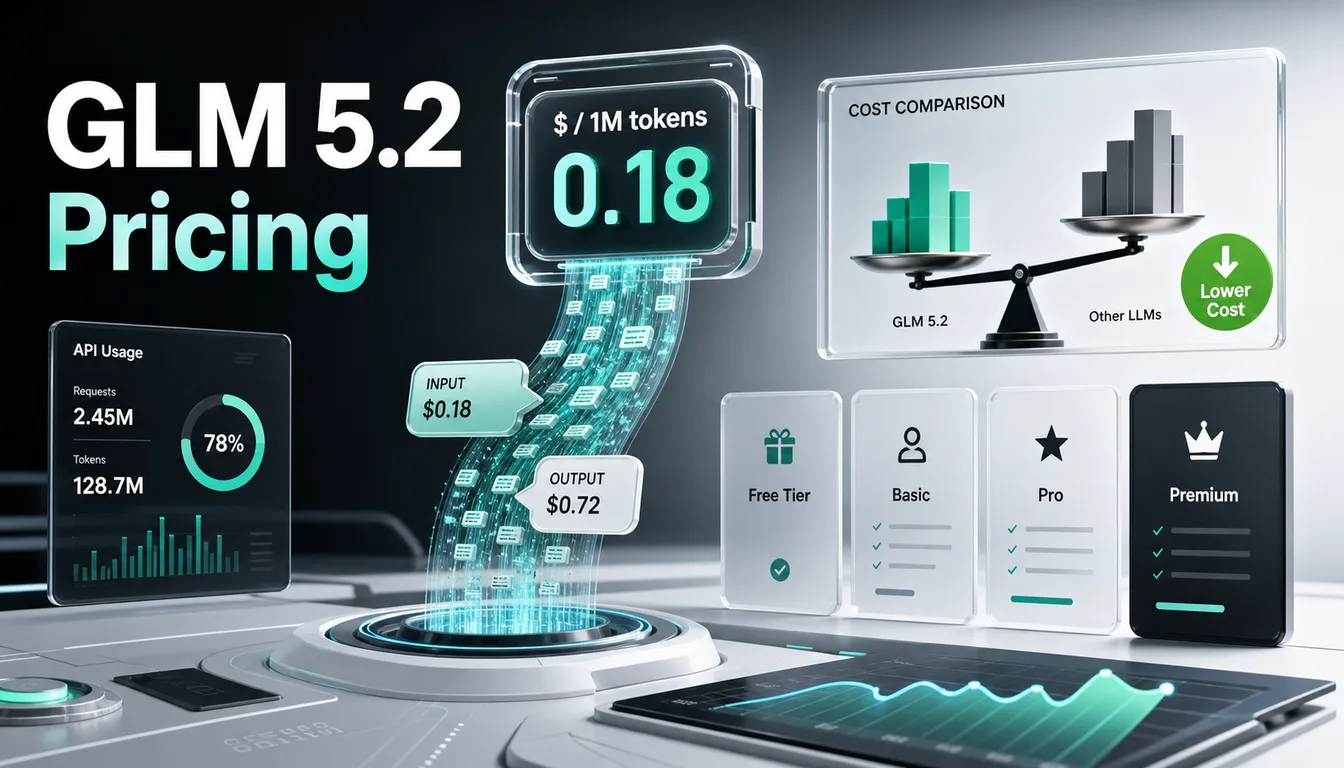
GLM 5.2 Pricing: API Cost, Subscription Plans & Free Tier (2026)
Complete guide to GLM 5.2 pricing in 2026: API token costs, GLM Coding Plan subscription tiers (Lite/Pro/Max/Team), OpenRouter rates, and how to get free access.
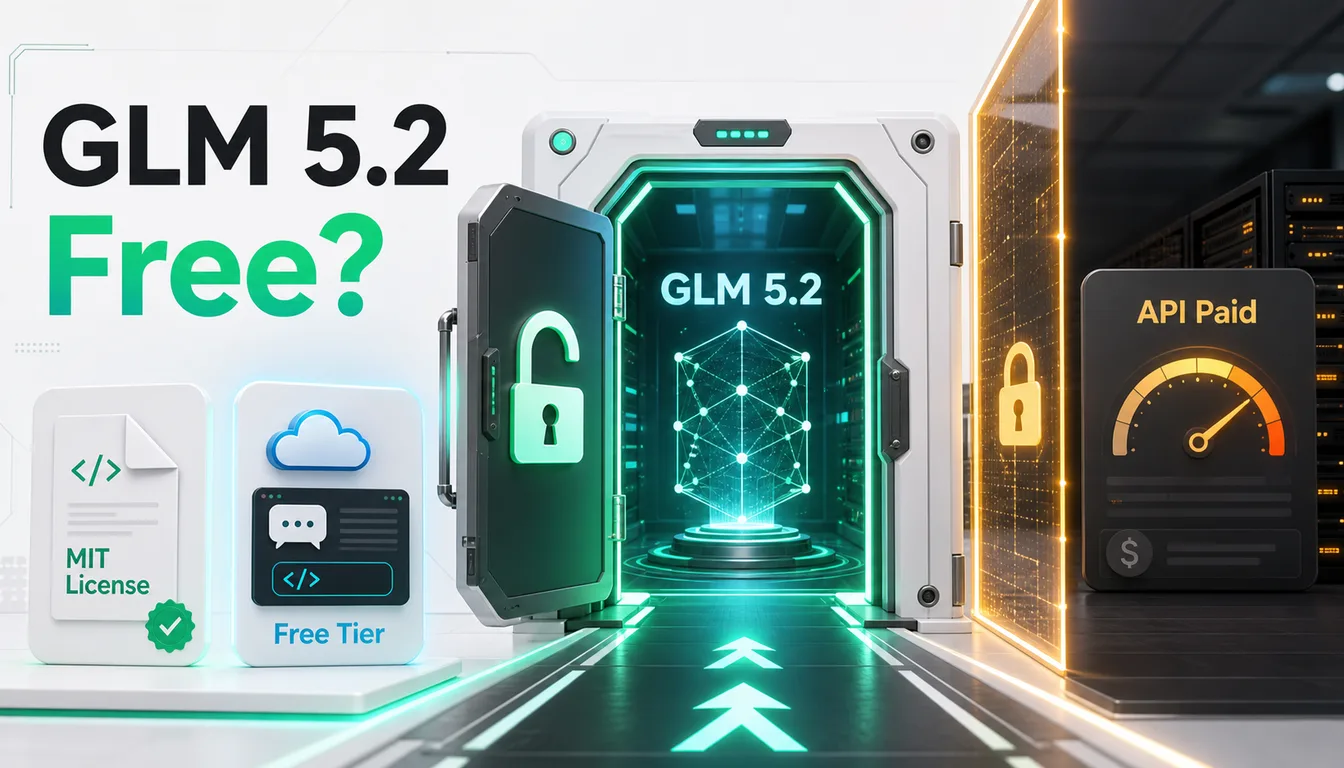
Is GLM 5.2 Free? Every Free Way to Use It in 2026
GLM 5.2 is free to download and self-host under the MIT license, and free to try via Cloudflare Workers AI and the z.ai web chat. This guide covers every free option and where paid plans kick in.
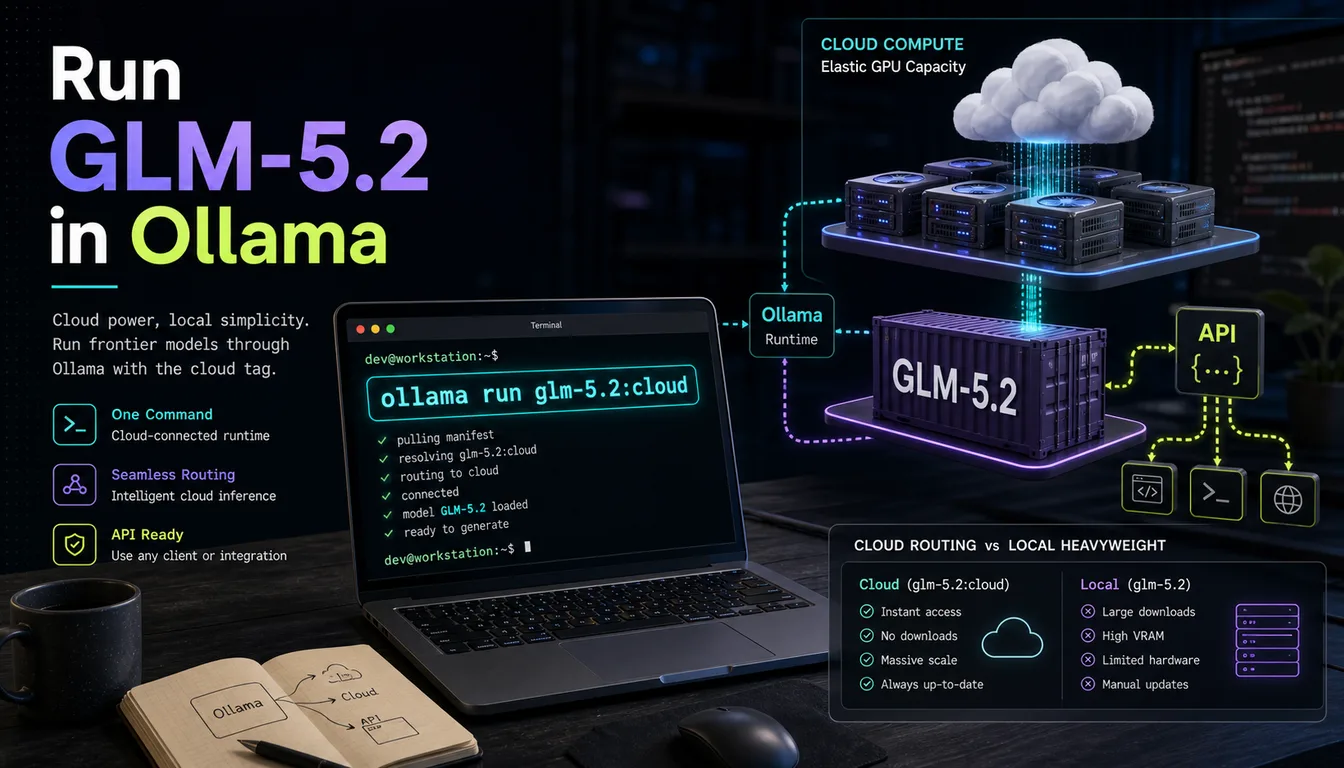
How to Run GLM-5.2 in Ollama: Cloud Tag, Local Setup & API Guide
GLM-5.2 is available in Ollama via the glm-5.2:cloud tag — one command gets you a 976K-context coding model without managing a 744B-parameter download yourself.
Still deciding what to read next?
Go back to the guide hub to browse model comparisons, setup walkthroughs, and hardware planning pages.