
Gemma 4 Guides
Kimi K3 vs Claude: Fable 5 and Opus 4.8 Compared
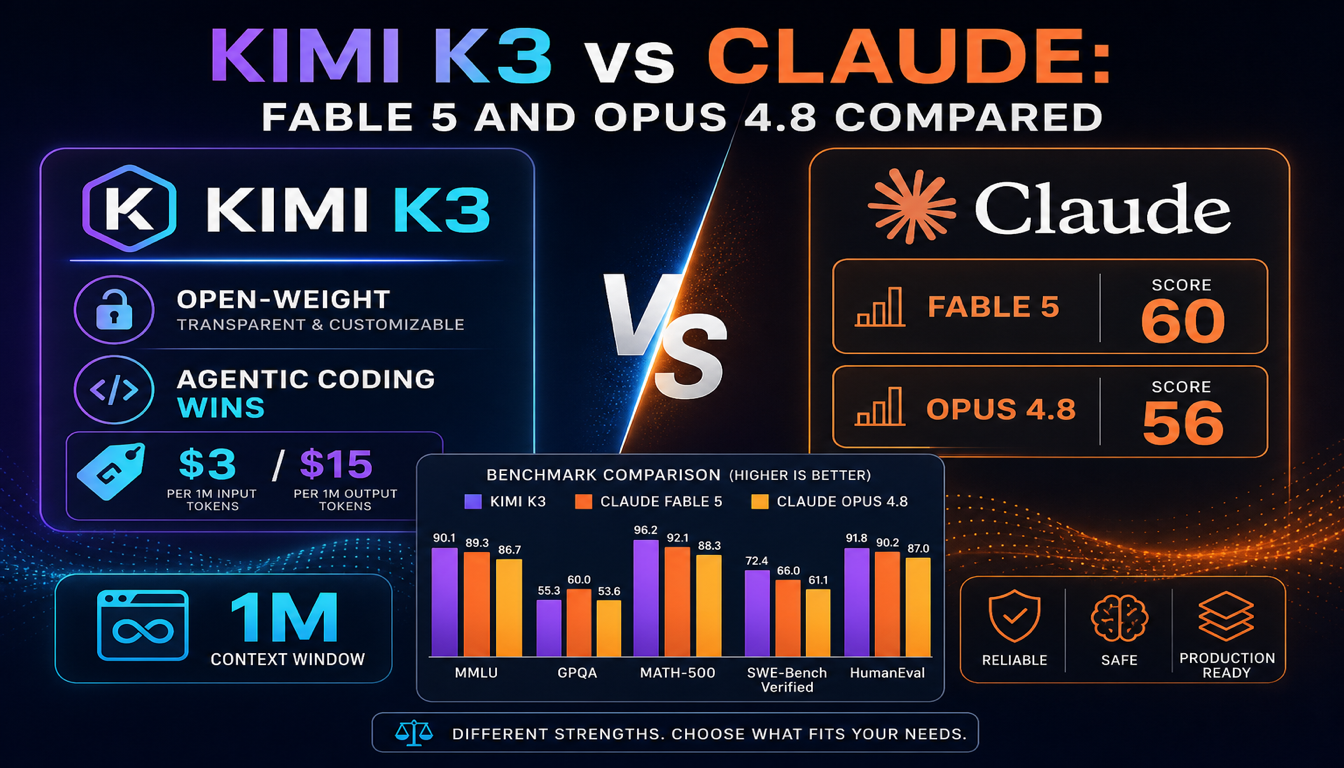
Kimi K3 vs Claude: Fable 5 and Opus 4.8 Compared
"Kimi K3 vs Claude" is really two separate questions, because "Claude" now spans two very different price-and-capability tiers: Claude Opus 4.8, still a strong frontier model, and Claude Fable 5, Anthropic's newer and more capable flagship. Kimi K3 sits in an interesting spot relative to both — it clearly beats Opus 4.8 on price and most benchmarks, while Fable 5 remains ahead on raw capability but at several times the cost.
This comparison uses Artificial Analysis's independent evaluation data alongside each vendor's published numbers, and ends with a straight recommendation by workload rather than a single "winner."
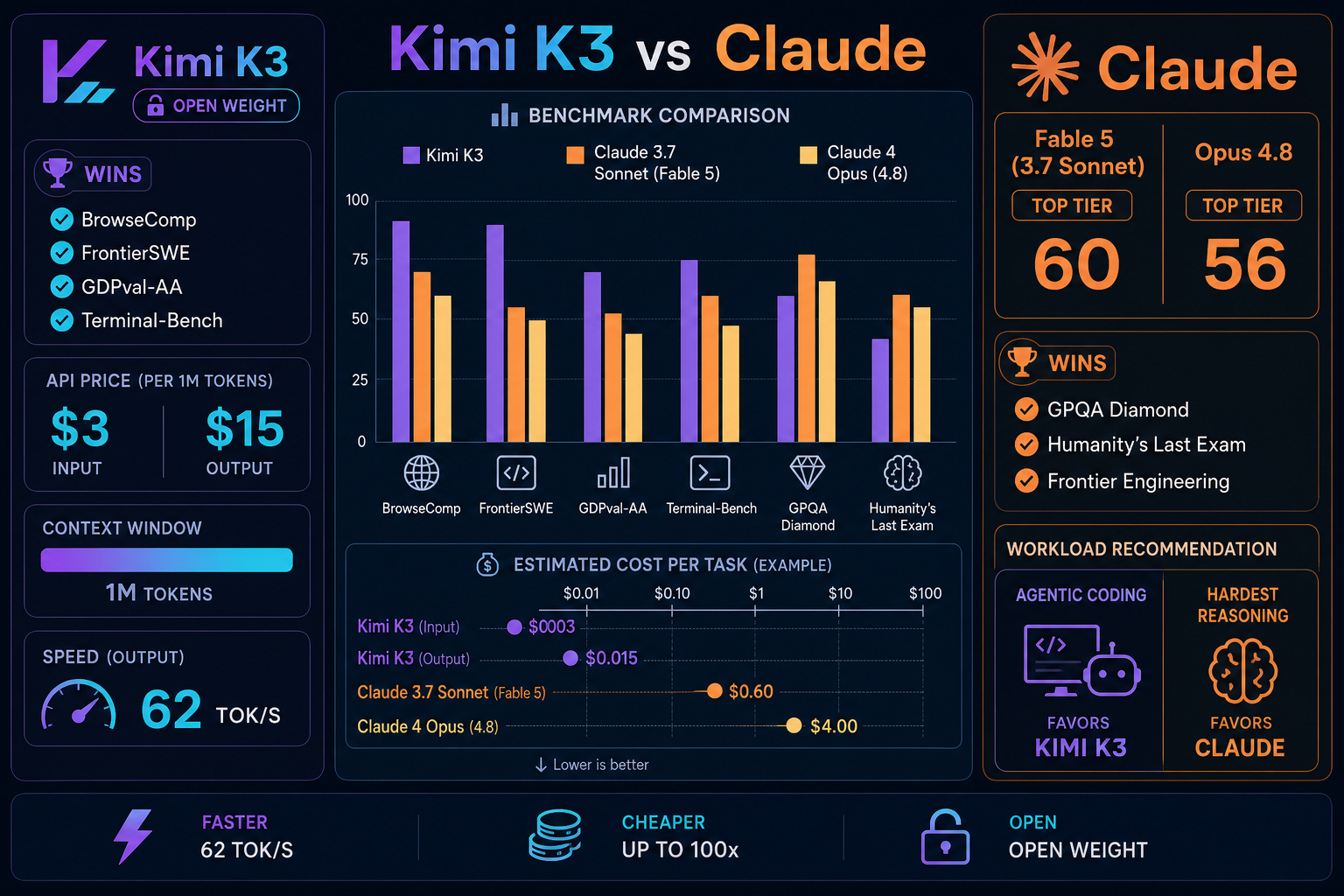
Quick answer
- Pick Kimi K3 if you're currently on Claude Opus 4.8 and care about cost-per-task — K3 beats it on both benchmarks and price.
- Pick Kimi K3 if your workload is long-horizon agentic coding, terminal-driven automation, or agentic web research — K3 wins these categories even against Fable 5, and at a fraction of the cost.
- Pick Claude Fable 5 if your workload is frontier-difficulty software engineering, professional knowledge work, or vision-heavy reasoning — Fable 5 leads most of these benchmarks.
- Pick Claude Fable 5 if a failed or wrong output is expensive — Fable 5's stronger judgment on hard tasks can be worth the higher token cost when errors are costly.
- Neither is a clean universal winner. The honest comparison depends on task type and how much a mistake costs you.
Release timing and positioning
| Kimi K3 | Claude Opus 4.8 | Claude Fable 5 | |
|---|---|---|---|
| Vendor | Moonshot AI | Anthropic | Anthropic |
| Released | July 16, 2026 | Earlier 2026 | 2026 (newer than Opus 4.8) |
| Positioning | Open-weight frontier generalist, agent-optimized | Frontier closed model | Anthropic's current flagship |
| Weights | Open-weight; public download pending (expected July 27, 2026) | Closed / API-only | Closed / API-only |
The framing worth internalizing: K3 isn't trying to be the smartest model in the world. It's trying to be close enough to frontier while being open-weight and dramatically cheaper — a different bet than Anthropic's, which is to keep pushing the capability ceiling regardless of price.
Benchmark comparison
Artificial Analysis Intelligence Index
| Model | Score |
|---|---|
| Claude Fable 5 (Adaptive, Max effort) | 60 |
| Kimi K3 | 57 |
| Claude Opus 4.8 (Adaptive, Max effort) | 56 |
K3 sits between the two Claude tiers on the composite score — ahead of the older flagship, behind the newer one.
Kimi K3 vs. Claude Opus 4.8 — category breakdown
Kimi K3 leads on: BrowseComp, CharXiv-R, DeepSearchQA, FrontierSWE, GDPval-AA, MCP Atlas, Toolathlon — 7 of 10 shared benchmarks.
Claude Opus 4.8 leads on: GPQA Diamond, Humanity's Last Exam, OfficeQA Pro — 3 of 10.
On GDPval-AA v2 specifically, K3 scores ~1,687 against Opus 4.8's 1,600.
Kimi K3 vs. Claude Fable 5 — category breakdown
Claude Fable 5 leads on: roughly 8 of 14 shared benchmarks, including a 5.4-point win on FrontierSWE and both visual-reasoning suites.
Kimi K3 leads on: roughly 6 of 14, including SWE Marathon (by ~7 points), BrowseComp, and Terminal-Bench 2.1.
On GDPval-AA v2, Fable 5 Max scores ~1,815 — the clear leader among the three.
What the pattern actually means
Across both comparisons, the same shape repeats: K3 is strongest on agentic, tool-using, and long-horizon coding tasks. Claude — both tiers, but especially Fable 5 — is strongest on frontier-difficulty engineering, academic reasoning, and vision-heavy evaluation. If your product looks like an autonomous agent grinding through tool calls, that favors K3. If it looks like "solve the single hardest problem correctly, cost secondary," that favors Claude.
Frontend coding: a genuinely independent signal
Most of the numbers above are vendor-reported or from a single evaluator. LMArena's Frontend Code Arena is different — it's a crowd-voted, independently-run leaderboard, and Kimi K3 took the #1 spot within hours of release, jumping from #18 and placing first in 6 of 7 frontend domains, ahead of Claude Fable 5. If frontend/UI generation is a meaningful part of your workload, this is one of the more credible data points in this entire comparison.
Speed and latency
| Metric | Kimi K3 | Claude Opus 4.8 (Max effort) |
|---|---|---|
| Output speed | ~62 tokens/sec | ~56 tokens/sec |
| Time to first token | ~1.99s | ~34.49s |
The time-to-first-token difference is the one users actually notice. Opus 4.8's max-reasoning-effort configuration spends a long time reasoning before the first visible token; K3's pipeline is tuned to start streaming much sooner. For latency-sensitive, user-facing products, this gap matters more than the raw tokens/sec figure.
Context window and output length
| Kimi K3 | Claude Opus 4.8 | |
|---|---|---|
| Context window | 1,048,576 tokens | Up to 1M tokens (tier-dependent) |
| Max output | Shares the ~1M budget | Capped around 128,000 tokens |
Both models handle roughly a million tokens of context. The practical difference shows up on the output side: Claude's max output is capped well below its context window, while K3's output budget draws from the same large pool. If your workflow involves generating very long single responses — a full codebase dump, an extensive report — K3's output ceiling is less restrictive.
Multimodal input
Unlike some open-weight comparisons where one model is text-only, this isn't a real differentiator here: both Kimi K3 and Claude support native image input and visual reasoning. Claude has offered strong vision capability for longer and leads several visual-reasoning benchmarks against Fable 5 specifically; K3's visual understanding is newer but built in natively rather than bolted on. If vision quality specifically is decision-critical, lean toward whichever model wins your specific vision benchmark of interest rather than assuming a modality gap — there isn't one.
Open weights vs. closed model
This is a real, structural difference that no benchmark table captures:
- Kimi K3 is designed to ship open-weight under a Modified MIT-style license. The actual weights are not downloadable yet (expected July 27, 2026), but once they are, self-hosting becomes possible — a meaningful option for teams with data residency requirements, air-gapped environments, or a desire to avoid per-token billing entirely at scale.
- Claude Opus 4.8 and Fable 5 are closed models, API-only, with no self-hosting path under any circumstances.
If self-hosting is a hard requirement for your use case, this single fact settles the comparison regardless of benchmark scores — Claude isn't an option, and K3 will be once its weights ship.
Pricing comparison
Published API rates
| Model | Cached input | Input | Output |
|---|---|---|---|
| Kimi K3 | $0.30 / MTok | $3.00 / MTok | $15.00 / MTok |
| Claude Opus 4.8 | — | $5.00 / MTok | $25.00 / MTok |
On raw input and output rates, Kimi K3 is roughly 1.7x cheaper than Claude Opus 4.8 on both ends.
Blended cost comparison
Using a representative 7:2:1 cache-hit:input:output token ratio (typical of an agentic coding session), independent analysis puts:
- Kimi K3: ~$2.31 per million blended tokens
- Claude Fable 5: ~$7.70 per million blended tokens
That's roughly a 3.3x cost gap against Fable 5 — larger than the Opus 4.8 comparison, since Fable 5 is priced at the premium end of Anthropic's lineup.
The one thing the price table doesn't capture
Kimi K3's thinking mode is always on and cannot be disabled — every call includes reasoning tokens billed as output, which can be substantial (independent testing has recorded 13,000+ reasoning tokens for short tasks at max effort). Claude gives you more granular control over reasoning depth. Before concluding "K3 is 3x cheaper" for your actual workload, model your real token mix including reasoning overhead — see the full Kimi K3 pricing breakdown for specifics.
Which one should you choose
Choose Kimi K3 if:
- You're currently on Claude Opus 4.8 and want a straightforward cost-and-benchmark upgrade.
- Your workload is long-horizon agentic coding, terminal automation, or agentic web research (BrowseComp, SWE Marathon, Terminal-Bench).
- Frontend/UI code generation is a core use case — K3's #1 LMArena Frontend Code Arena result is independently verified.
- You need (or will soon need) self-hosted, open-weight deployment.
- Cost-per-task at scale matters more than squeezing out the last few points of capability.
Choose Claude Fable 5 if:
- Your workload is frontier-difficulty software engineering or professional knowledge work where Fable 5's benchmark lead is real.
- Vision-heavy reasoning is central to your product.
- A wrong or failed output is expensive enough that the higher per-token cost is worth paying for stronger judgment.
- You need the most capable model available regardless of price.
Choose Claude Opus 4.8 if:
- You need Anthropic's ecosystem and tooling specifically, but don't need Fable 5's newer capability ceiling.
- Your workload leans toward GPQA-style academic reasoning or Humanity's Last Exam-style knowledge tasks, where Opus 4.8 still edges out K3.
Recommendation by workload
| Workload | Pick |
|---|---|
| Long-horizon autonomous coding agent | Kimi K3 |
| Frontier-difficulty software engineering | Claude Fable 5 |
| Frontend / UI generation | Kimi K3 |
| Agentic web research | Kimi K3 |
| Vision-heavy document or image analysis | Claude Fable 5 (test both) |
| Academic reasoning / science QA | Claude (either tier) |
| Cost-sensitive, high-volume agent workload | Kimi K3 |
| Self-hosted / on-prem requirement | Kimi K3 (once weights ship July 27, 2026) |
| Lowest possible latency to first token | Kimi K3 |
| Highest achievable accuracy, cost secondary | Claude Fable 5 |
Final verdict
There's no single winner here, and pretending otherwise would be dishonest to the actual numbers. Against Claude Opus 4.8, Kimi K3 is close to a clean upgrade — cheaper, faster to first token, and ahead on most shared benchmarks. Against Claude Fable 5, the picture is genuinely mixed: Fable 5 still leads on the hardest engineering and reasoning tasks, but K3 wins the categories that matter most for autonomous agents — long-horizon coding, terminal work, and web research — while costing roughly a third as much.
The practical move: if you're building an agent that grinds through many tool calls and long tasks, test K3 first. If you're solving individual hard problems where correctness matters more than cost, test Fable 5 first. Either way, model your actual token mix — including K3's always-on reasoning overhead — before committing, using the pricing guide as a starting point.
FAQ
Is Kimi K3 better than Claude? Depends which Claude. K3 beats Claude Opus 4.8 on the Artificial Analysis Intelligence Index and 7 of 10 shared benchmarks, at a lower price. Against Claude Fable 5, Fable 5 wins more benchmarks overall (roughly 8 of 14), but K3 wins on long-horizon agentic coding and costs about a third as much.
Is Kimi K3 cheaper than Claude? Yes, on both raw per-token rates and blended cost. K3 is roughly 1.7x cheaper than Claude Opus 4.8 per token, and roughly 3.3x cheaper than Claude Fable 5 on a representative blended workload. Note that K3's always-on reasoning tokens add cost that isn't visible in the headline per-token price.
Does Kimi K3 beat Claude Fable 5? Not overall. Fable 5 wins more shared benchmarks and has a higher Artificial Analysis Intelligence Index score (60 vs. 57). K3 does beat Fable 5 on specific categories: long-horizon agentic coding (SWE Marathon), BrowseComp, Terminal-Bench 2.1, and LMArena's Frontend Code Arena.
Can I self-host Kimi K3 instead of using Claude? Not yet — Kimi K3's public weights are expected by July 27, 2026. Claude models are closed-source and never offer a self-hosting path. Once K3's weights ship, it becomes the only one of the two with an open-weight option.
Which is faster, Kimi K3 or Claude? K3 has a notably shorter time-to-first-token (~2 seconds vs. Claude Opus 4.8's ~34 seconds in max-effort reasoning mode) and slightly higher output throughput (~62 vs. ~56 tokens/sec).
Is Kimi K3 as good as Claude for coding? For long-horizon, multi-step, and frontend coding tasks, K3 is competitive with or ahead of both Claude tiers. For the single hardest frontier software-engineering benchmark (FrontierSWE), Claude Fable 5 still leads by a measurable margin.
Related guides
Related guides
Continue through the Gemma 4 cluster with the next guide that matches your current decision.
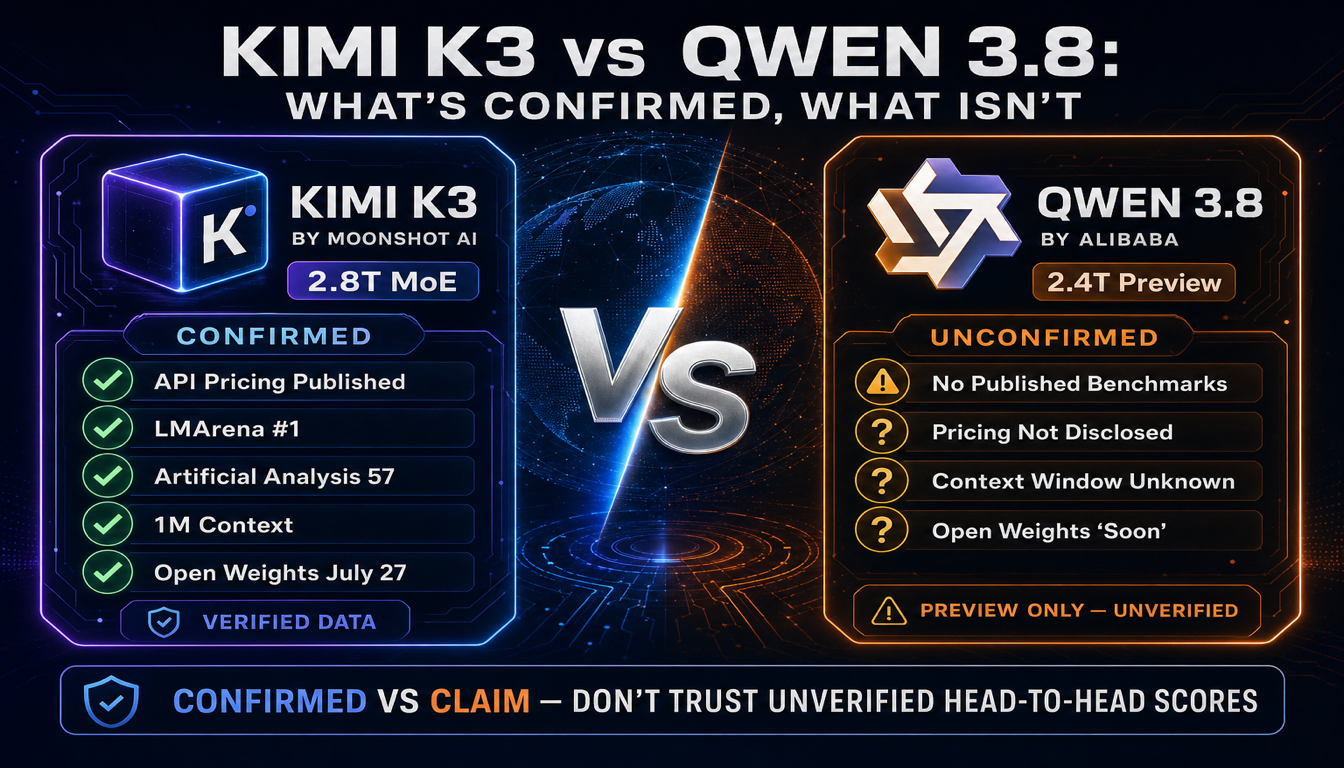
Kimi K3 vs Qwen 3.8: What's Confirmed, What Isn't (July 2026)
Alibaba previewed Qwen 3.8 three days after Kimi K3 launched, calling it "second only to Fable 5." Problem: Qwen 3.8 doesn't have a single published benchmark yet. Here's what's actually confirmed on both sides before you pick one.
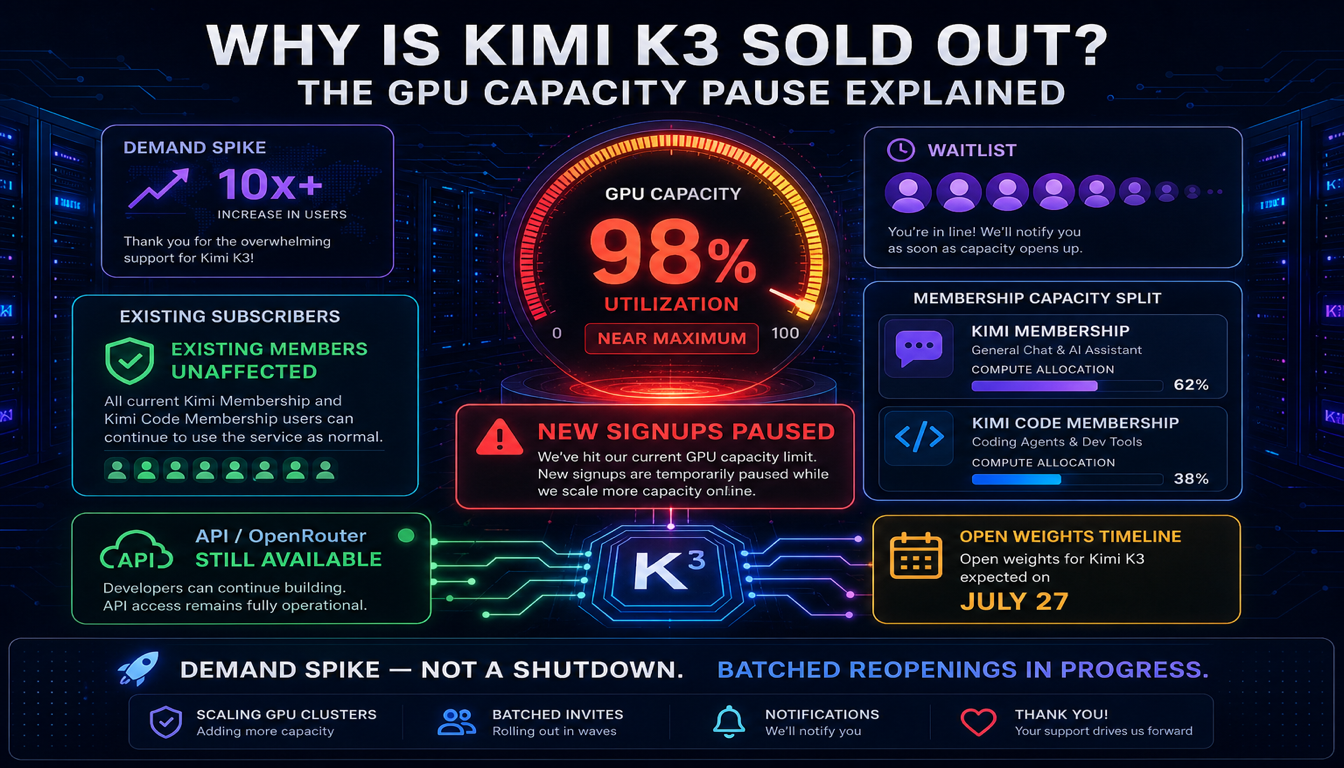
Why Is Kimi K3 Sold Out? The GPU Capacity Pause Explained
Kimi K3 isn't discontinued or actually "sold out" — Moonshot paused new subscription signups after demand maxed out its GPU capacity within 48 hours of launch. Here's what that means if you're trying to get access right now.
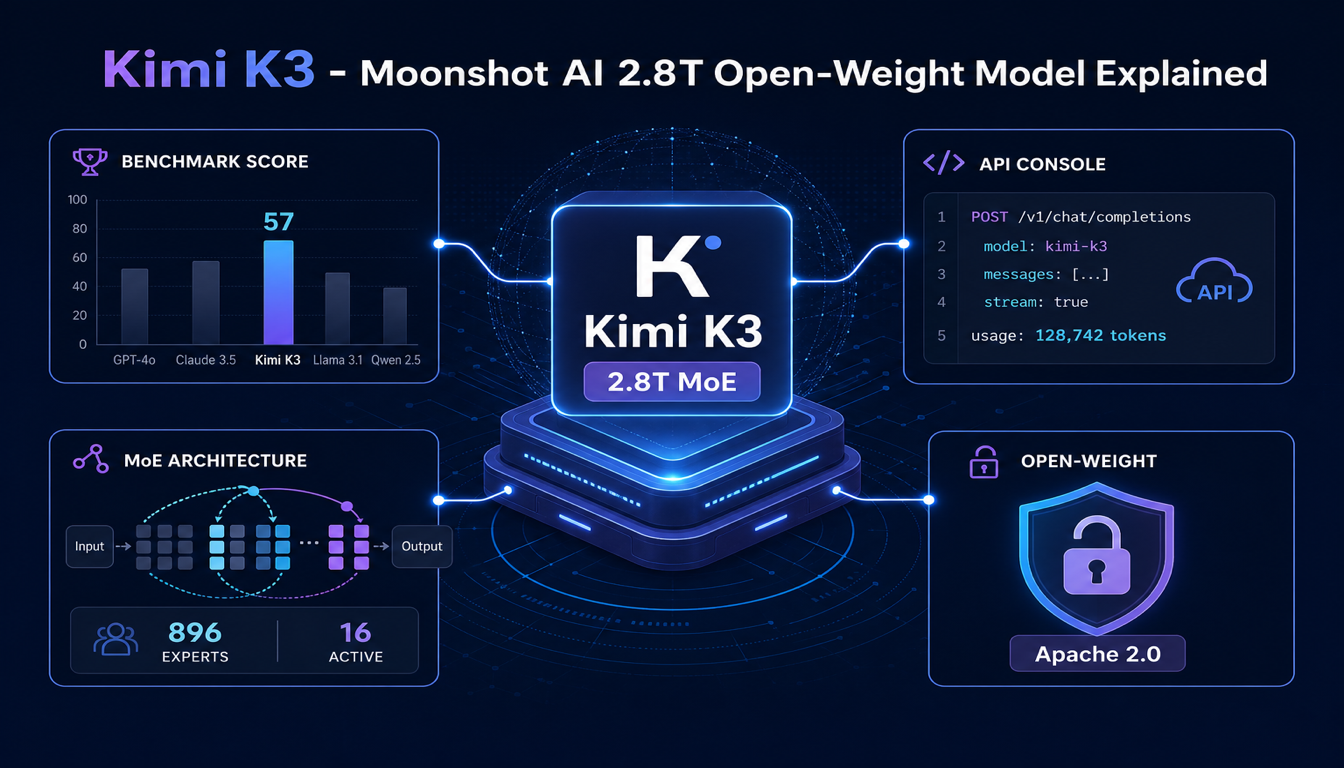
Kimi K3: Moonshot AI's 2.8T Open-Weight Model Explained
Moonshot AI's Kimi K3 launched July 16, 2026 as a 2.8-trillion-parameter open-weight model that beats Claude Opus 4.8 on several benchmarks. Here is what it actually is, what's still missing, and how to try it today.
Still deciding what to read next?
Go back to the guide hub to browse model comparisons, setup walkthroughs, and hardware planning pages.